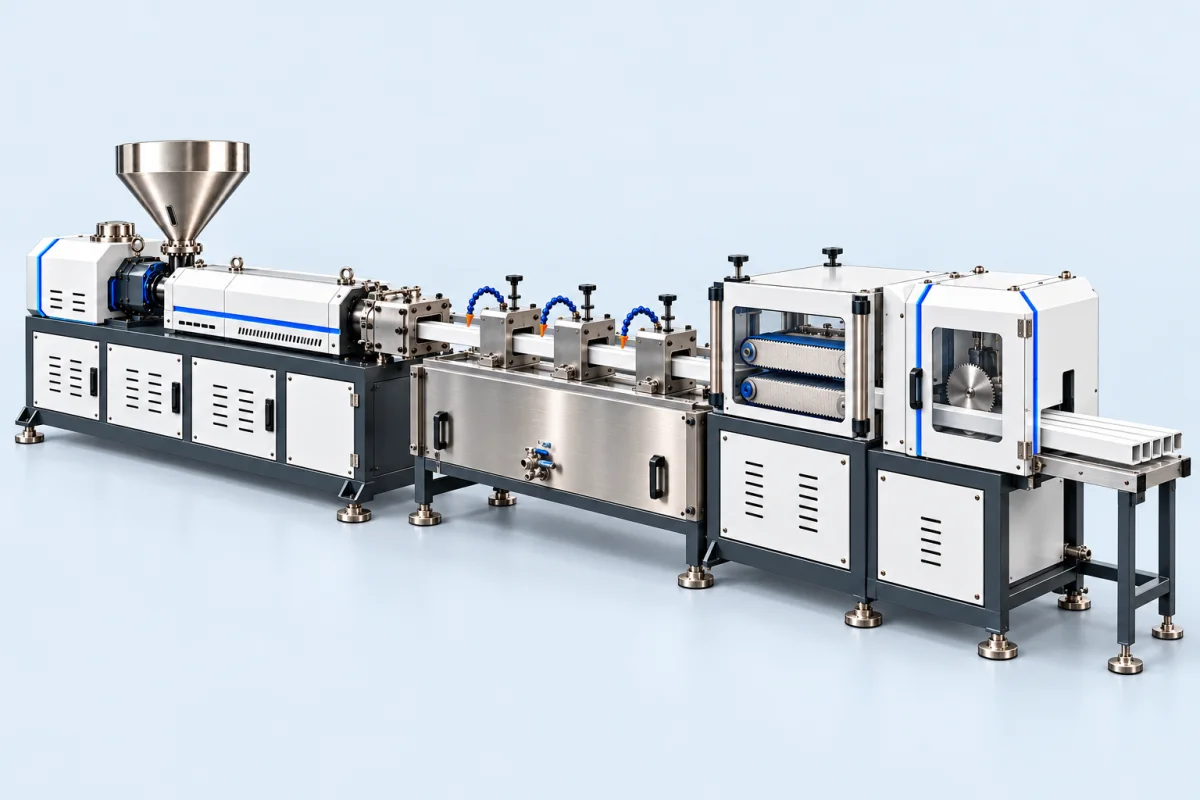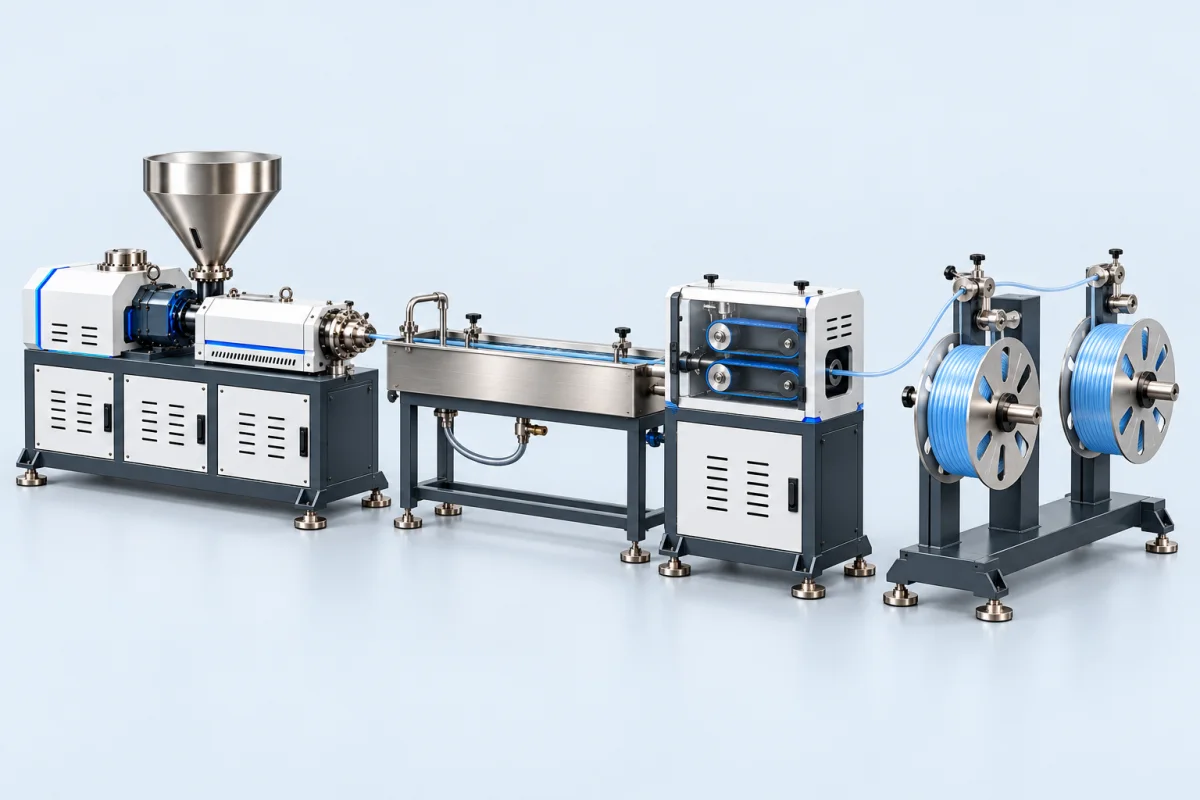

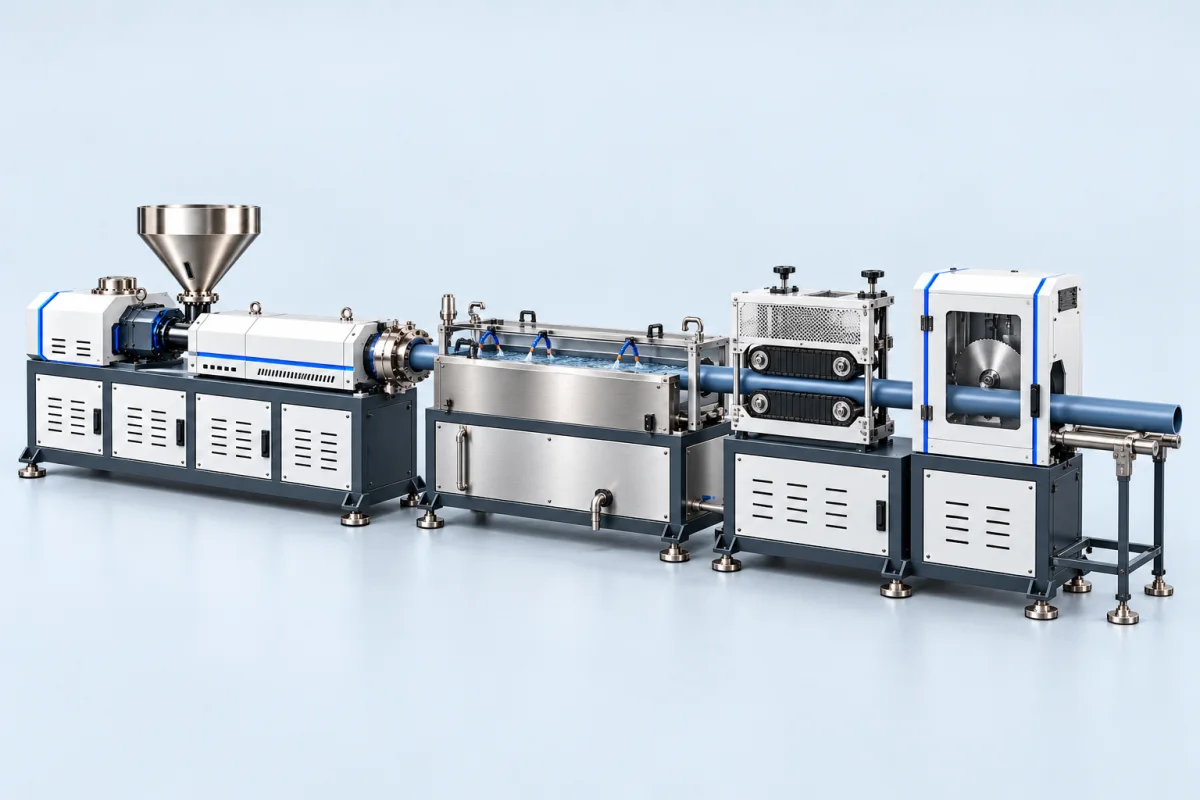
The usable product is downstream
An extrusion line should be assessed at the point where the product meets its agreed acceptance conditions. Material leaving a die is only an intermediate state. Sizing, cooling, pulling and finishing influence the shape and handling condition of the final item. A purchasing brief that concentrates on the extruder can overlook limitations elsewhere in the line.
Start by naming the product attributes that matter after finishing: dimensions, straightness, surface condition, cut quality or coil behavior. Then ask how each downstream component contributes to those attributes. The purpose is to establish a connected process description, not to prescribe a universal equipment sequence. Different materials and geometries require different arrangements and operating windows.
Review the sizing approach for the actual product
Calibration or sizing should be discussed against the material grade and section geometry. Vacuum equipment is one established approach, but its presence alone does not establish dimensional performance. Ask about product support, alignment and the relationship between the die and the first downstream stage. Identify which dimensions are controlled and which are verified by inspection.
For flexible or moisture-sensitive material families, avoid copying a setup from a different polymer merely because the products look similar. Resin suppliers publish processing guidance for particular materials, and those recommendations help frame the equipment discussion. Any application-specific departures should be reviewed explicitly. A general product category does not replace grade information and trial evidence.

Treat cooling water as part of the specification
Provide the water conditions the site can actually maintain, including relevant seasonal variation. A tank proposal and a plant cooling system answer related but different questions. The line needs a defined process condition, while the utility system must support the associated heat-removal duty. Ask the supplier to identify connection requirements and the assumptions used in the proposal.
Discuss water circulation, filtration, temperature monitoring and maintenance responsibilities. If a chiller or separate cooling circuit is needed, identify who sizes and supplies it. Conair's cooling guidance emphasizes the combined process heat load rather than a machine label alone. Use that principle to request a project-specific assessment instead of borrowing a rule of thumb from an unrelated production case.
Specify pulling without losing the product
The haul-off must move the extrusion through its downstream path while respecting its condition and surface requirements. Ask how contact length, gripping arrangement and adjustment relate to the actual section. Belt or caterpillar equipment can be configured in different ways; the product brief should explain the duty that matters rather than selecting a type by appearance.
Record which surfaces may be contacted and whether marks or deformation are acceptable. Review pulling and upstream output together when discussing dimensional stability. The cutter or coiler also needs to fit the same operating case. A suitable puller should be evaluated as part of the connected line, including normal adjustment and changeover work.
| Product requirement | Question for the equipment review |
|---|---|
| Critical dimensions | How will sizing, pulling and the measurement point be coordinated? |
| Visible surfaces | Which surfaces may contact belts or supports, and what marks are acceptable? |
| Water conditions | What supply temperature, circulation and filtration assumptions apply? |
| Finished format | What supports, cutting method or winding arrangement suit the deliverable product? |
Scroll horizontally to compare all columns.
Place inspection where it answers the requirement
Identify the stage at which each acceptance measurement is meaningful. Some checks may support process control while others establish whether finished product can be released. Keep those purposes separate. A dimensional instrument installed on the line does not automatically validate every final-product requirement, especially if later handling or the defined conditioning interval affects what is measured.
Agree how measurement results will be associated with operating conditions and product lots. State who responds when a reading moves outside the agreed limits and how affected material is handled. These are production-workflow decisions as much as equipment choices. They should be visible in the brief before a control option is described as solving the quality problem.
Review finishing and access together
Cutting, coiling and collection affect both product condition and floor-space needs. A layout should show how finished items are removed without obstructing the operator or the next product length. For coils, describe the required format and handling restrictions. For straight lengths, specify cut quality and support needs. Include these requirements before approving the downstream equipment arrangement.
Maintenance access also occupies space. Operators need to reach tanks, service points and adjustment mechanisms, while tooling changes may require movement of equipment. Review those activities with plant personnel instead of treating the line footprint as the only dimension that matters. A tightly packed drawing can conceal a process that is awkward to operate or maintain.
Use a connected acceptance case
For the proposed trial, name the product drawing, resin grade, relevant water conditions and the final measurement method. Record output, downstream settings and quality observations together. If a target is not achieved, review the whole chain before assuming that more extruder capacity is the solution. The limiting condition may belong to a different stage.
Bring these questions to an ARKPM pipe, profile or tubing project discussion: what must be controlled, where is it measured, which utility conditions apply, and how does the product leave the line? The answers help turn separate equipment descriptions into a reviewable production proposal. Numerical performance should remain tied to that agreed case rather than being treated as universal.
Further technical reading
Manufacturer documentation can help explain process principles. These references do not describe ARKPM equipment or establish ARKPM performance claims.