
LDPE Film Squeezer vs. Hot-Air Dryer Before Pelletizing
Compare LDPE film squeezing and hot-air drying before pelletizing. Learn what to test for moisture, feeding stability, energy use and accepted pellet output.

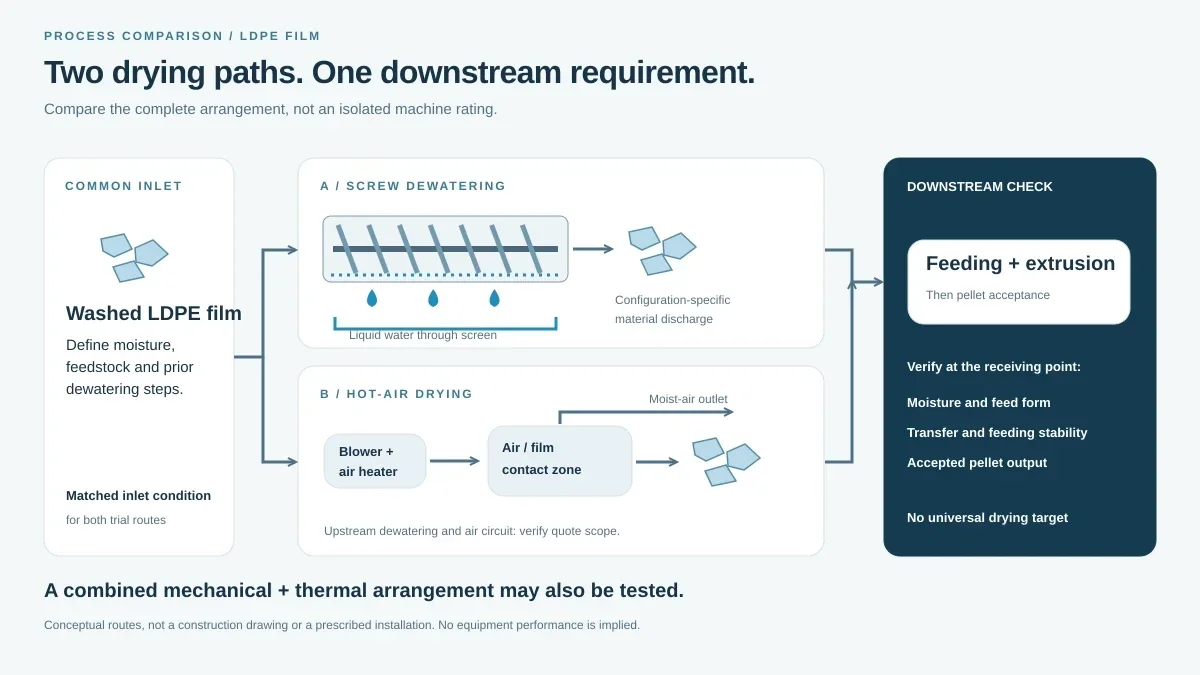
Choosing how to dry washed LDPE film before pelletizing
Choosing between an LDPE film squeezer and a hot-air dryer is not simply a question of which machine leaves less water behind. A useful comparison asks what each configuration delivers to the pelletizing line: a measurable moisture level, a feed form the downstream equipment can handle, and consistent production of acceptable pellets.
Start with the complete process rather than a machine name. Ask suppliers to identify where washed film enters their proposed drying arrangement, where measurements will be taken, and which feeding equipment receives the discharge. Two quotations can describe different process boundaries while appearing to offer the same drying duty.
This guide explains how to compare those proposals without treating advertised moisture figures or installed motor power as guaranteed results. The most useful buying decision comes from a representative material trial with agreed sampling, energy measurement and pellet acceptance criteria.
Understand what “squeezer” means in the quotation
A screw-based dewatering machine uses compression to separate water from wet material. Herbold’s EPS engineering sheet describes a conical screw, hydraulic counterpressure and a surrounding screen through which separated water leaves. It also describes arrangements combining mechanical dewatering with final thermal drying, rather than presenting one universal layout. Herbold EPS engineering sheet
Squeezers are not all configured alike. KITECH distinguishes a hydraulic screw press with loose discharge from a heated, semi-plasticizing configuration that produces denser material. These are manufacturer-specific examples of why buyers should establish the discharge form, not assume every machine sold as a squeezer performs the same task. KITECH auxiliary machine configurations
Ask each supplier to describe its exact machine in plain language. Does it primarily remove water, also change material density, or combine several functions? Which functions are included in the quoted price? Where are motors, heaters, discharge devices and collection equipment counted? A clear answer makes later energy and production comparisons much more meaningful.
Define the hot-air drying duty precisely
For a hot-air drying proposal, request a process description showing the air-heating source, air circuit, material transport and discharge arrangement. Ask which upstream dewatering steps the proposal assumes. A quotation for finishing an already dewatered stream should not be evaluated as if it covers the full duty from freshly washed film.
Clarify what the supplier guarantees at the stated incoming moisture, feed rate and ambient conditions. Record whether the quoted energy includes fans, heaters and associated conveying. If heat comes from fuel or a shared utility, request the measurement boundary for that consumption as well.
Do not reduce this comparison to a slogan that mechanical drying is always better or that thermal drying is always necessary. Ask suppliers to justify the complete arrangement against your feedstock and downstream requirements. A combined arrangement is also a legitimate candidate for testing, not an admission that either individual machine has failed.
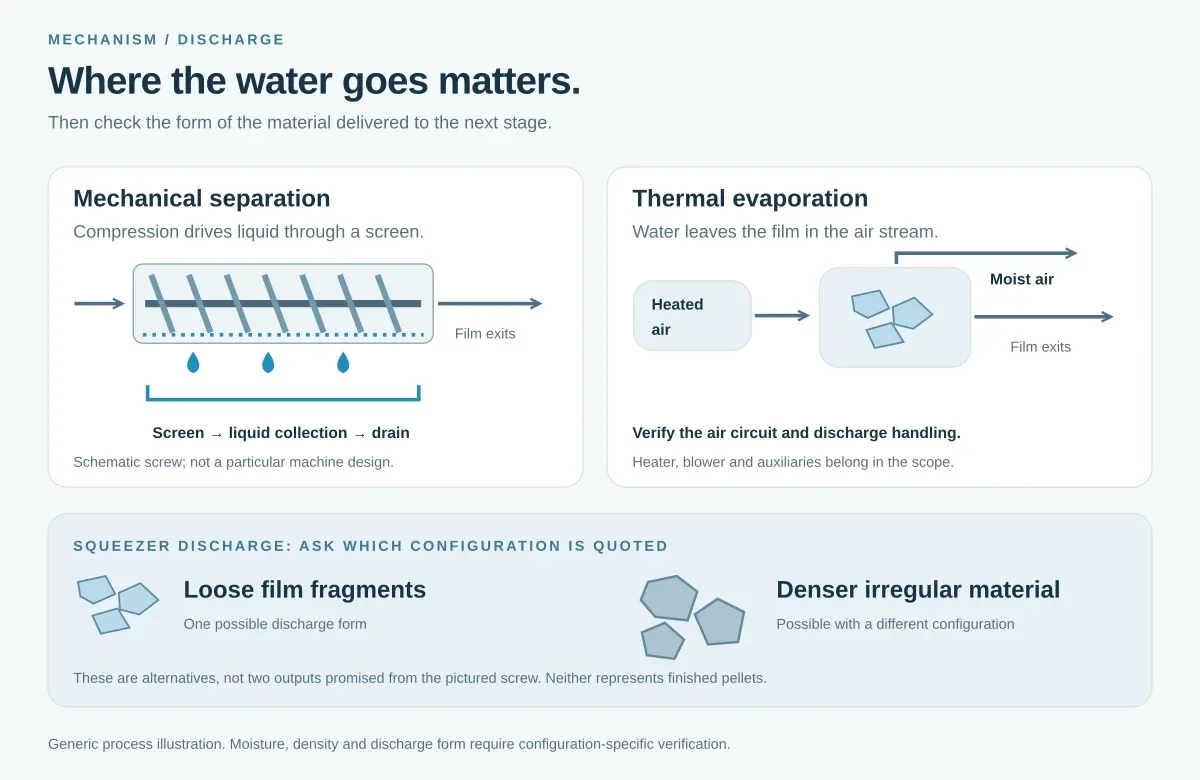
Mechanical dewatering and hot-air drying remove water in different ways. Check the condition of the actual discharge.
Describe the material that will actually reach the dryer
“LDPE film” is too broad a purchase specification. Prepare a feedstock description that distinguishes clean production scrap from washed post-consumer material and identifies known mixtures, printing, contamination and thickness variation. Record how the film has been sorted, cut, washed and dewatered before it reaches the trial boundary.
Use photographs of representative material, but do not let photographs replace samples or measurements. Ask the supplier which characteristics could change the proposed process or invalidate a capacity claim. Record those exclusions before comparing prices.
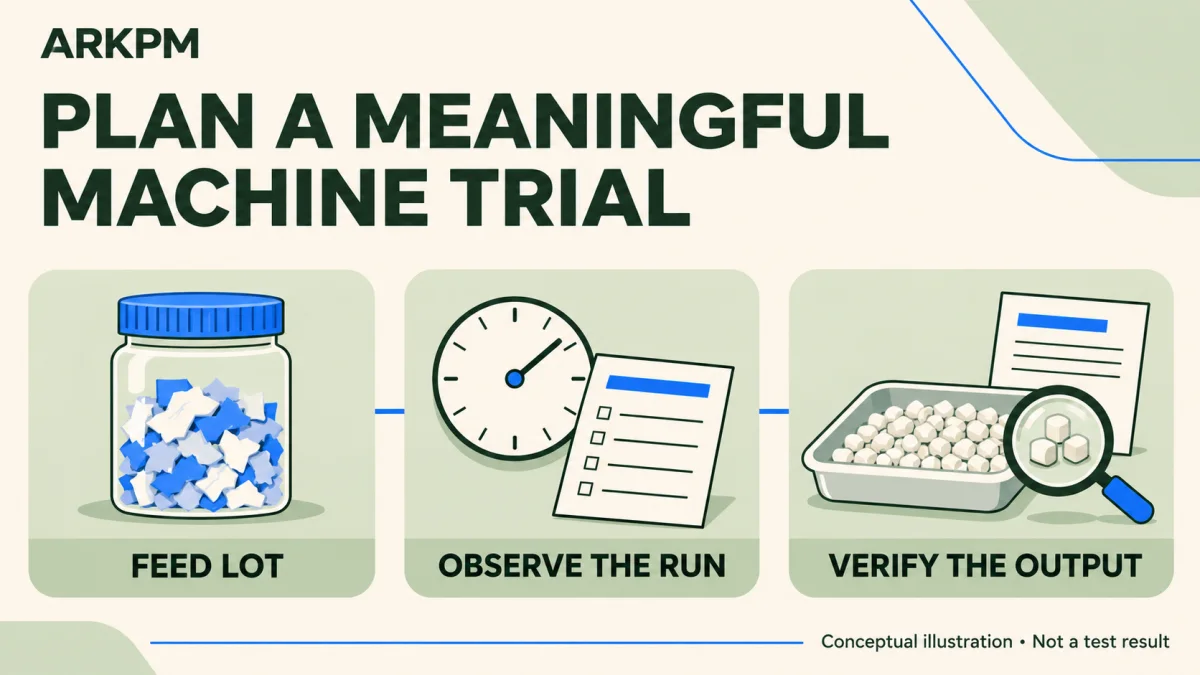
Where possible, reserve enough material from one representative lot for both configurations. If only different lots can be tested, document that limitation and avoid interpreting the results as a controlled comparison. Do not quietly substitute unusually clean or convenient material for the feedstock on which the investment decision depends.
For washed film, make the handover point particularly clear. Does the supplied sample represent the material directly after washing, after preliminary drainage, or after an existing mechanical dryer? Label each sample accordingly. Otherwise, a trial may answer a different question from the one your production line presents.
Field-collected mulch film: does the quote start at dirty bales or washed flakes?
If your material arrives as field-collected agricultural mulch film, establish the washing scope before comparing dryers. A price for processing dirty bales and a price for processing prepared washed flakes do not cover the same work. Figure 3-3 of the European Commission’s Agricultural Plastics study shows that the mix of soil, water and film can vary by crop. It illustrates why the composition of your own lot matters; it is not a specification for your bales.
Ask both suppliers to begin with the same representative lot. Record as-received bale mass, water, dry soil and other non-polymer material separately, and document how you estimated the dry polyethylene content. Report accepted pellets on a dry basis and state whether recovery is measured against incoming wet mass or estimated dry polyethylene. The figures answer different questions: the first describes yield from each tonne you receive; the second estimates how much of the incoming polymer becomes usable output.
Use the ARKPM film recycling and pelletizing line page as a starting point. Ask for the exact inlet condition in the written quote and count washing or drying as included only when the quote lists those stages. If the line is quoted for prepared flakes, identify who supplies upstream soil removal and washing and where prepared material is handed over.
Agree on moisture measurement before agreeing on a target
A residual-moisture percentage is useful only when both parties understand its basis. Specify whether the percentage is calculated relative to the total wet sample mass or the dry material mass. Record the sampling location, collection procedure and analysis method.
Request a written procedure for sealing, labeling and handling samples between collection and measurement. The protocol should explain how material from different points in the run is represented, rather than relying on one favorable grab sample. Ask the testing party to identify the method’s limits and any non-water losses that could affect the result.
A loss-in-weight test reports a change in sample mass; it does not identify the individual substances lost. ASTM D6980-25 describes that limitation. The RecyClass PE-film recyclability protocol also treats flake preparation before pellet production and pellet conditioning before blown-film evaluation as separate steps with different laboratory targets. Neither target is a production dryer guarantee. Agree on the sampling point, test method and limit for the actual process being quoted.
Use the pelletizer supplier’s written feed requirements to establish the acceptance target. Do not adopt a percentage from an unrelated machine advertisement as a universal specification for LDPE recycling. A buyer needs evidence that the proposed discharge meets the requirements of the actual downstream configuration under the agreed conditions.
Test feeding behavior alongside discharge moisture
Include discharge handling and pelletizer feeding in the trial scope. Request observations of transfer, storage where applicable, dosing and interruptions. Record the condition in which the material reaches the pelletizer, not only its condition at the drying-machine outlet.
If bulk density is part of the comparison, agree on a container, filling procedure and whether the sample is loose or compacted. Report the method with the number. Otherwise, two measurements labeled “bulk density” may describe differently prepared samples.
Track output over defined time intervals and record adjustments made during the run. Ask whether operators changed feeder settings, extrusion conditions or other equipment to accommodate either configuration. These changes are not automatically disqualifying, but they must be visible when interpreting performance. The aim is a workable process, not a flattering isolated dryer result.
Compare energy over the same operating boundary
Installed power and measured energy are different quantities. A motor’s kilowatt rating is not the number of kilowatt-hours consumed during a production trial. Request meter readings over a defined interval, together with the material masses processed during that interval.
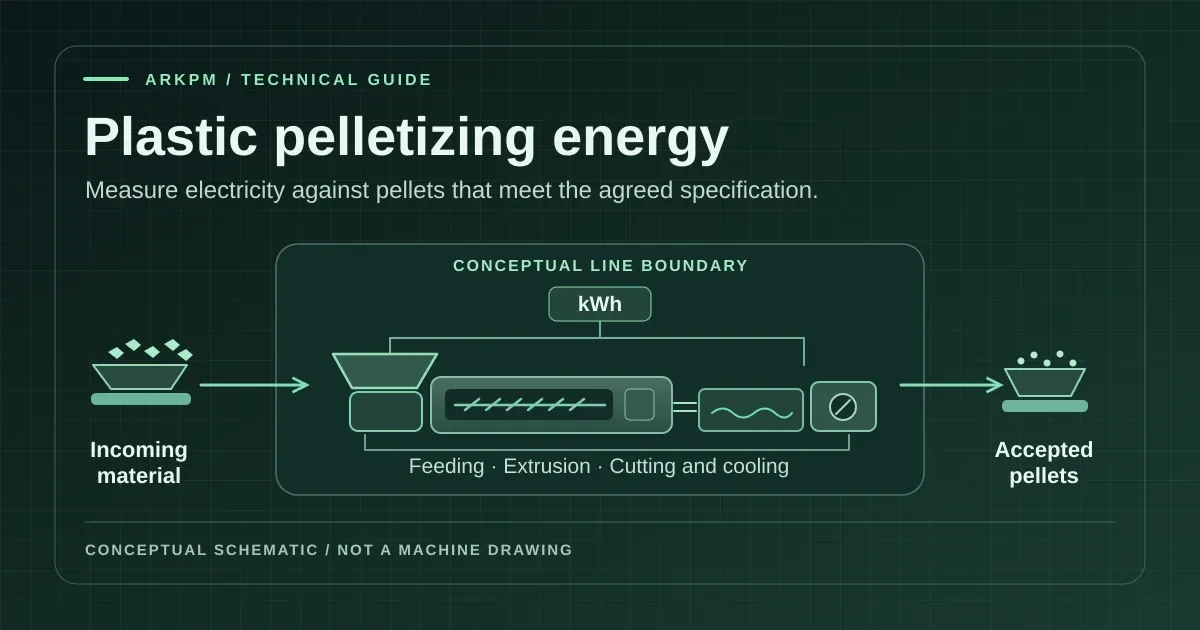
Draw the boundary around the equipment being compared. For a drying-section comparison, identify every included motor, fan, heater and auxiliary. For a washing-to-pellets comparison, include the same production stages in both alternatives. Do not compare a stand-alone machine reading with the electricity of an entire line.
Keep electricity and non-electric fuel measurements separate. State how shared utilities are allocated, and distinguish measured values from estimates. A year-long industrial study used meter-based operating data to assess recycling processes; it provides a useful example of evidence-led analysis, not a performance guarantee for another plant. Industrial recycling energy study
Report energy per input tonne and per accepted pellet tonne
Report both denominators when evaluating the whole line. Energy per input tonne shows consumption relative to incoming material. Energy per accepted pellet tonne relates it to the output that actually meets the agreed acceptance criteria.
For a drying comparison, write down both the scale reading and the moisture basis. A 100 kg sample at 12% wet-basis moisture contains 12 kg of water and 88 kg of dry material. That same sample is about 13.6% moisture on a dry basis. This is an illustration about reporting units, not a dryer target or ARKPM test result.
If wet-basis and dry-basis percentages are mixed, two technically identical samples can appear different on a quote. When weight is lost in a drying trial, account separately for water, any fines or material removed during handling, and any material held in the equipment. Do not relabel the entire change as water removal.
Use the same moisture basis for each takeoff point. Compare accepted output after feeding, extrusion and the agreed quality checks, not just the mass at the dryer outlet. Report electricity, fuel and other cost components separately so the buyer can apply the local tariff.
Establish what counts as an acceptable pellet
Before testing, agree on the checks that determine whether pellet output is accepted, rejected or held for further evaluation. Choose criteria relevant to the intended customer or product, rather than assuming every pellet leaving the line is saleable.
Document the test method, sampling interval and decision rule for each criterion. Depending on the application, the buyer may request checks covering moisture, contamination, appearance or specified material properties. These are items to agree with the relevant technical parties, not universal acceptance limits supplied by this article.
Record rejected material and reprocessing separately. If a trial ends with material still inside the equipment or in intermediate storage, identify it rather than counting it as finished output. A transparent mass record helps the buyer understand both measured throughput and the denominator used in cost calculations.
Run a comparison that can survive scrutiny
Agree in advance how startup, adjustment periods, steady operation and shutdown will be recorded. Do not remove unfavorable periods from one result while leaving them in the other. Present steady-operation data separately from total-run figures when both are useful.
Record the trial date, feedstock lot, equipment arrangement, operator adjustments and interruptions. Use matching clocks for production and utility measurements. Ask for the underlying readings, not just a summary chart or edited video.
Repeat measurements across the run to see whether a headline result is representative. If capacity or sample availability prevents a full production-scale trial, describe the limitation explicitly. A demonstration can establish that a process runs; it cannot automatically establish annual production, seasonal performance or a guaranteed payback period.
Use the same trial plan when discussing both alternatives. ARKPM’s plastic pelletizing machine trial guide provides a related starting point for preparing the wider equipment evaluation.
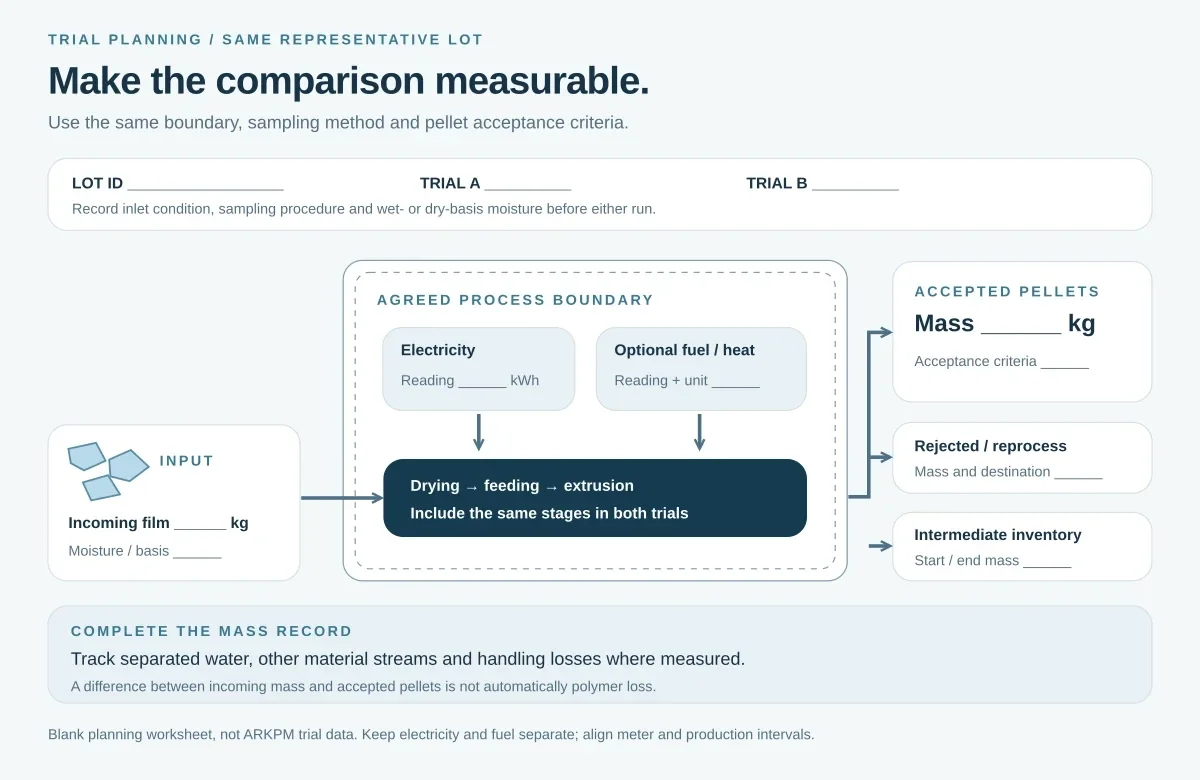
Use the same washed film lot and compare measured boundaries, stable throughput and accepted output.
Look beyond the electricity bill
Ask for a maintenance schedule and a list of wear components for each proposed arrangement. Request access requirements, recommended inspection intervals and the conditions under which quoted parts life applies. Do not accept an unsupported annual maintenance allowance as a substitute for identifying the components involved.
Review the site interfaces with the supplier. These include material transfer, drainage, utilities, access space and the handling of water, air or fines leaving the process. Ask which equipment is included and which must be provided by the buyer.
Have the installation and operating risks assessed by qualified personnel for the actual site. Guarding, hot surfaces, isolation procedures and safe maintenance access belong in the project review. A lower purchase price is not a saving if necessary interfaces or safeguards have simply been left outside the quotation.
Translate the trial into a purchase specification
Turn the accepted trial method into a written specification. Define the feedstock envelope, incoming conditions, throughput basis, moisture method, output acceptance criteria and energy boundary. State which results are contractual guarantees and which are estimates or observations.
Identify what happens if incoming material falls outside the agreed envelope. Ask the supplier how performance will be checked during commissioning, who will provide instruments and samples, and how disagreements will be resolved. Clarify whether the acceptance test covers the dryer alone or the connected pelletizing line.
For a retrofit, request confirmation of the connection to existing equipment before placing an order. A proposal should explain what remains unchanged, what must be modified and which existing limitations remain the buyer’s responsibility. Avoid assuming that successful operation in a supplier’s demonstration line guarantees identical results in a different installation.
Choose the configuration that meets your production requirements
Choose on the strength of a complete, comparable proposal. If a squeezer-based arrangement meets the agreed moisture, feeding and pellet-quality requirements, evaluate it on its measured operating cost and integration needs. If additional thermal drying is proposed, ask the supplier to demonstrate the duty it performs and include that duty in the comparison.
Do not select equipment solely because it advertises the lowest residual moisture or the largest hourly capacity. The relevant result is repeatable production of accepted pellets from your material within a clearly defined operating and maintenance scope.
When discussing an LDPE film recycling and pelletizing line with ARKPM, prepare the feedstock description, representative photographs, existing process layout, target accepted pellet output and available trial data. Ask for a configuration-specific proposal and clearly stated assumptions. This gives both parties a practical basis for evaluating the drying stage before committing to equipment.