
Plastic Pelletizing Energy Cost per Ton: Measure Accepted Output
Compare plastic pelletizing electricity cost per accepted tonne. Learn how to measure kWh, yield, drying, auxiliaries and trial boundaries before buying.

Plastic Pelletizing Energy Cost per Ton Starts with the Output You Can Use
Plastic pelletizing energy cost per ton is most useful when it describes the electricity required to produce pellets that meet an agreed specification. A tonne of incoming scrap is not automatically a tonne of accepted pellets. Water, contamination, screen-change waste, start-up material and off-spec production can change the relationship between the amount entering a line and the output a buyer can use.
For procurement, ask for two figures from the same measured run: electricity per incoming metric tonne and electricity per accepted metric tonne. The first describes energy consumption relative to material processed. The second connects energy to usable output. Neither number is meaningful unless the supplier also identifies the process boundary, feedstock, measurement interval and acceptance criteria.
Throughout this guide, one metric tonne means 1,000 kg. A US short ton is a different unit and must not be mixed into the same comparison. The worked examples are illustrative calculations, not measured ARKPM machine performance.
The objective is not to find the lowest number on a specification sheet. It is to establish what that number includes, whether the output meets your requirements, and whether the result can be repeated with your material.
Calculate kWh per Input Tonne and per Accepted Tonne Separately
Start with three measured quantities: electricity consumed during the reporting interval, incoming material mass assigned to that interval, and the corresponding accepted pellet mass. Use net material weights, excluding bags, pallets and containers.
Electricity per input tonne = measured electricity in kWh ÷ incoming mass in metric tonnes.
Electricity per accepted tonne = measured electricity in kWh ÷ accepted pellet mass in metric tonnes.
Accepted-output yield = accepted pellet mass ÷ incoming mass.
When both mass figures use the same defined basis and refer to the same material balance, electricity per accepted tonne also equals electricity per input tonne divided by accepted-output yield. Enter yield as a fraction: 84% becomes 0.84, not 84.
This relationship is a calculation, not a promise about a machine. If you change the material, operating conditions or acceptance threshold, both electricity consumption and yield may change. Do not assume that improving one variable leaves the others constant.
The two denominators answer different questions. Input-based intensity can help describe a waste-treatment service or an upstream handling load. Accepted-output intensity is usually more relevant when comparing the electricity cost of producing a specified pellet product. Report both rather than replacing one with the other.
Worked Example: One Run, Two Different Energy Costs
Consider an illustrative run that consumes 420 kWh while processing 1,000 kg of incoming film. After the agreed inspection and testing, 840 kg of pellets qualify as accepted output. Assume the meter includes all equipment inside the stated trial boundary and the mass accounting has been reconciled.
The incoming mass is 1.000 metric tonne. The accepted pellet mass is 0.840 metric tonne. Accepted-output yield is therefore 84%.
On an incoming-material basis, the run uses 420 ÷ 1.000 = 420 kWh per tonne. On an accepted-output basis, it uses 420 ÷ 0.840 = 500 kWh per tonne. Expressed in the units some supplier quotations use, that is 0.42 kWh/kg of incoming film and 0.50 kWh/kg of accepted pellets. Multiply kWh/kg by 1,000 to convert to kWh per metric tonne on the same mass basis.
At an illustrative electricity energy rate of USD 0.12/kWh, the metered electricity costs USD 50.40 for the run. That is USD 50.40 per input tonne, but USD 60.00 per accepted tonne.
Both calculations are correct. They describe the same run with different denominators. A quotation that shows only USD 50.40 per tonne could understate the electricity cost assigned to usable pellets if the reader assumes the denominator is accepted output.
The difference between 1,000 kg and 840 kg should not automatically be described as plastic loss. It could include removed water, dirt, labels, other materials, rejected pellets or changes in material retained inside the equipment. Record the categories rather than assigning an explanation without evidence.
This example excludes fuel, demand charges, labour, maintenance, disposal and capital costs. Its USD 60 figure is an electricity energy-charge calculation, not a full production cost.
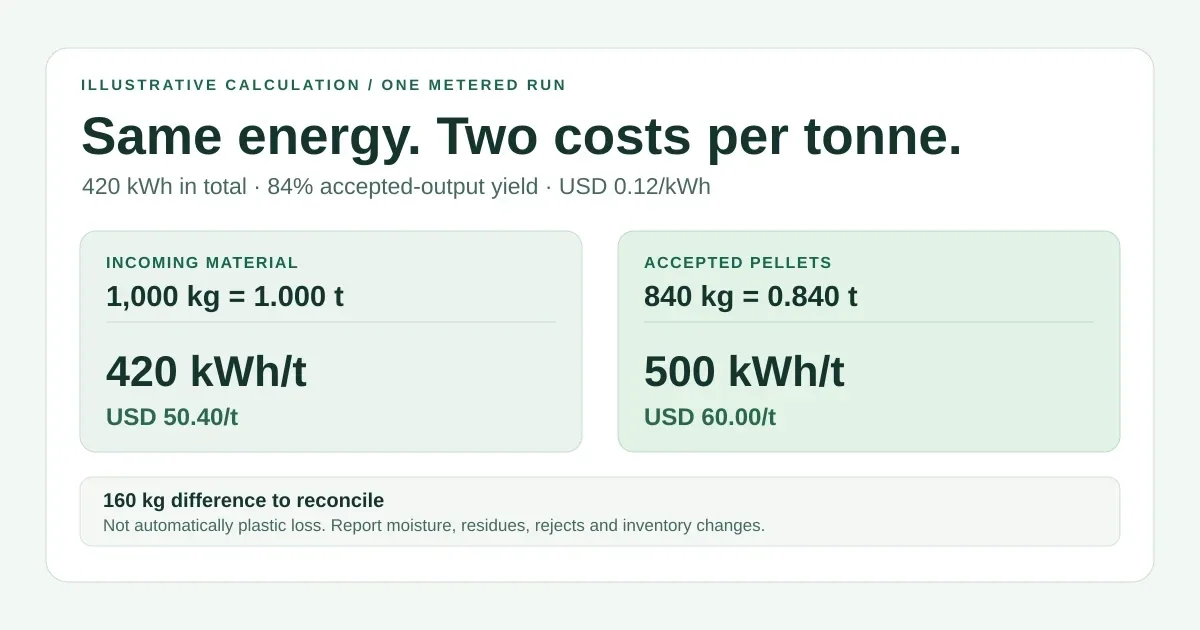
Illustrative calculation only. The same 420 kWh run gives different results depending on which tonnes are counted.
Define What the Pelletizing Energy Figure Includes
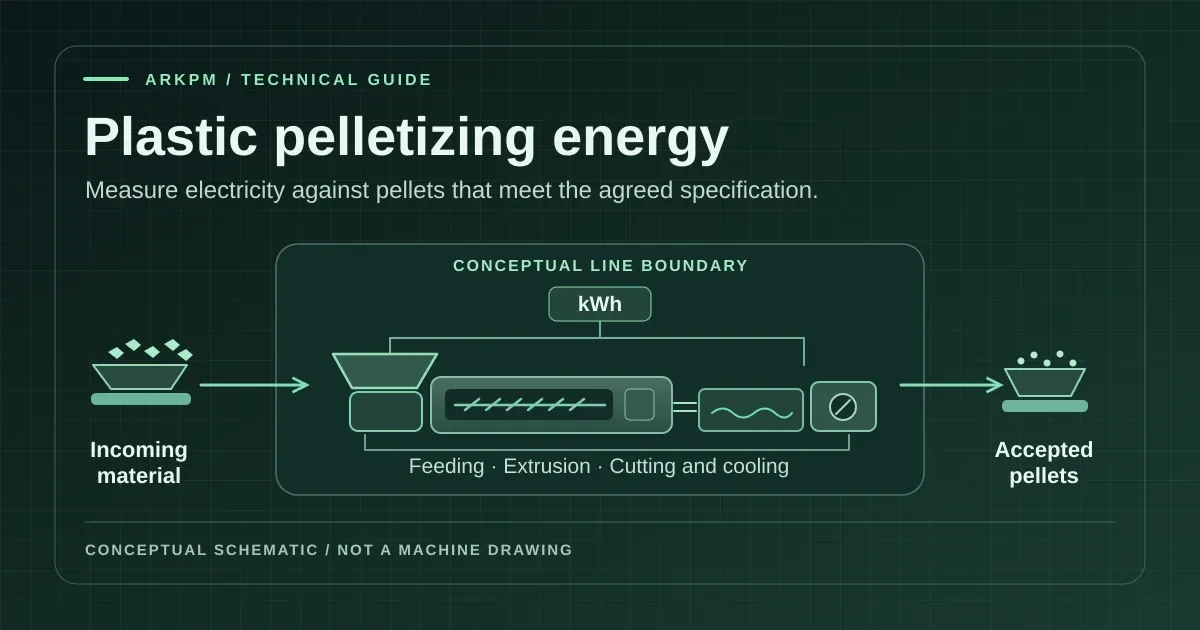
A pelletizer-only meter and a whole-line meter do not measure the same service. Before discussing efficiency, draw a simple boundary around the equipment being compared.
An extrusion and pelletizing boundary may include the feeding arrangement, extruder drive, barrel heaters, vacuum equipment, filtration system, pellet cutting and associated cooling. Another supplier may quote only the extruder drive. A recycling-line boundary may additionally include size reduction, washing, mechanical dewatering, thermal drying, water treatment and conveying.
Shared utilities need particular care. A central chiller or compressor may serve several lines. If its electricity is included in a site bill but excluded from the trial meter, show it separately and explain the allocation. Do not simply add a whole central utility reading to each line.
Assign every relevant load to one of three categories: directly measured, allocated by a stated method, or excluded. This makes a comparison reviewable even when perfect submetering is unavailable. It also prevents a buyer from mistaking an estimate for a direct observation.
Published industrial research illustrates why boundaries matter. Martín-Lara and colleagues studied a Spanish post-consumer polyethylene-film recycling plant by separating sorting, washing, extrusion and wastewater treatment. That is a useful reminder that an extrusion-only result does not describe the complete recycling process. The study is a particular plant case, not a universal performance specification. Read the University of Granada study record.
In that Spanish plant’s Table 2 inventory, the functional unit is 1 kg of recycled LDPE pellets. Drying within the washing section accounts for 0.18240 kWh/kg, equivalent to 182.4 kWh per metric tonne of pellets; extrusion accounts for 0.26430 kWh/kg, equivalent to 264.3 kWh per tonne. These are separate stage inventories from that plant. Neither figure is a whole-line benchmark, and neither demonstrates ARKPM performance. See the primary inventory, Table 2.
For a request for quotation, write the boundary in plain language. “Electricity measured from prepared-feed entry through accepted-pellet discharge, including the listed auxiliaries” is more useful than an unexplained “low energy consumption” statement.
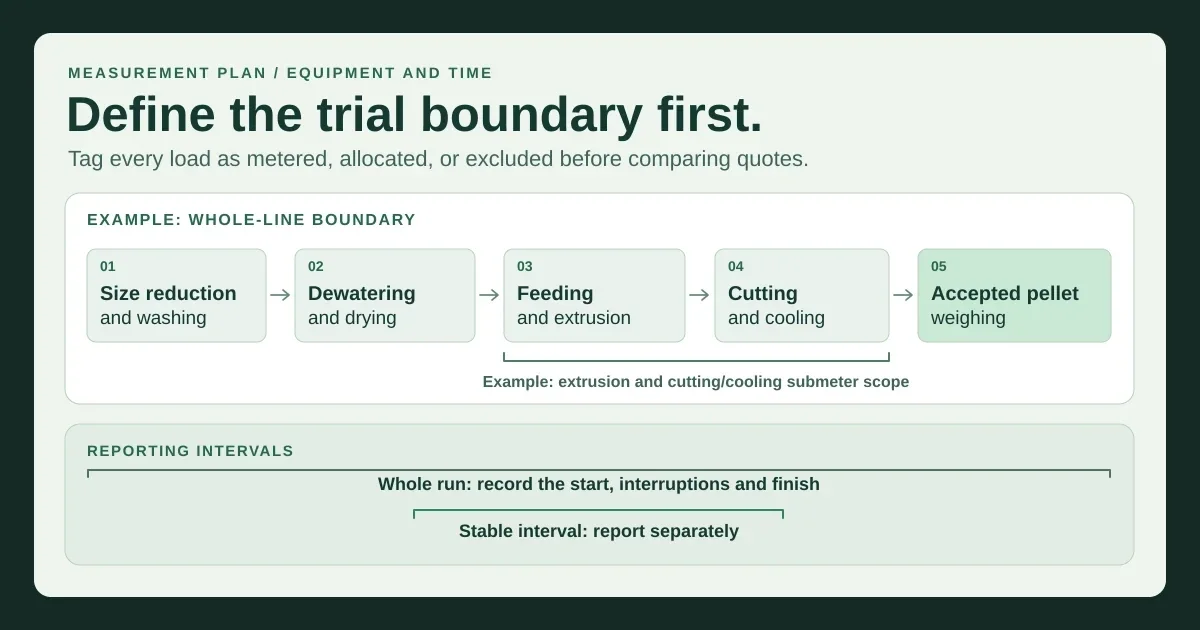
Specify which loads are metered, allocated or excluded before comparing accepted pellet output.
Use Metered Energy, Not Installed Power, as the Final Evidence
Installed power describes equipment ratings. It is not the same as the electricity consumed during a production run. Likewise, an instantaneous kW reading is a rate of energy use, not a kWh total.
The preferred trial evidence is the difference between cumulative electricity-meter readings over a defined interval, supported by timestamps and an equipment list. Have a qualified electrical professional select and install suitable measurement equipment. Record the meter identity, verification status and any relevant measurement limitations.
Average electrical power can be calculated by dividing measured kWh by elapsed hours. That can help explain the run, but it should not replace the recorded cumulative energy readings.
For example, a line drawing an illustrative average of 150 kW and producing 300 kg of accepted pellets per hour would use 500 kWh per accepted tonne under those conditions. At the same average power but only 200 kg/h accepted output, the calculation becomes 750 kWh per accepted tonne. These are arithmetic scenarios, not predictions that power stays constant as throughput changes.
A supplier may reasonably provide an engineering estimate before a trial. Ask it to identify the assumptions and label the result as estimated. Keep estimated, measured and guaranteed values in separate fields so that an early budget figure does not become an unintended contractual promise.
Reconcile Wet Feed, Dry Material and Accepted Pellets
Moisture can distort a comparison even when the electricity meter is accurate. A tonne of wet incoming film contains less dry material than a tonne of dry film. Reporting only kWh per incoming wet tonne can therefore create a misleading impression of performance.
Record whether incoming mass is as received, after washing, after dewatering or on a calculated dry basis. State the moisture measurement method, sampling point and whether the percentage is wet basis or dry basis.
For wet-basis moisture, the arithmetic is:
Dry mass = wet mass × (1 − wet-basis moisture fraction).
An illustrative 1,000 kg feed at 10% wet-basis moisture contains 900 kg of dry material. This does not mean it contains 900 kg of usable polymer: the dry fraction may still include contamination or unwanted materials.
If a dry-basis moisture value is supplied, do not insert it into that wet-basis equation. Confirm the definition and convert it explicitly before comparing records.
Track additives and blending material separately as well. Accepted pellets may contain material added during processing. Counting that added mass as recovered scrap would overstate recovery from the incoming waste stream.
Reconcile opening and closing work in progress. Material already inside a line at the start, material remaining at the end, and recycled internal rejects can otherwise make a short trial appear to produce more or less than it really does. When the balance cannot be reconciled, retain the measured readings but mark the specific-energy result as provisional.
Define “Accepted” Before Starting the Trial
Accepted pellets must meet a specification agreed before the run. “Pellets produced” and “pellets accepted” should not be interchangeable labels.
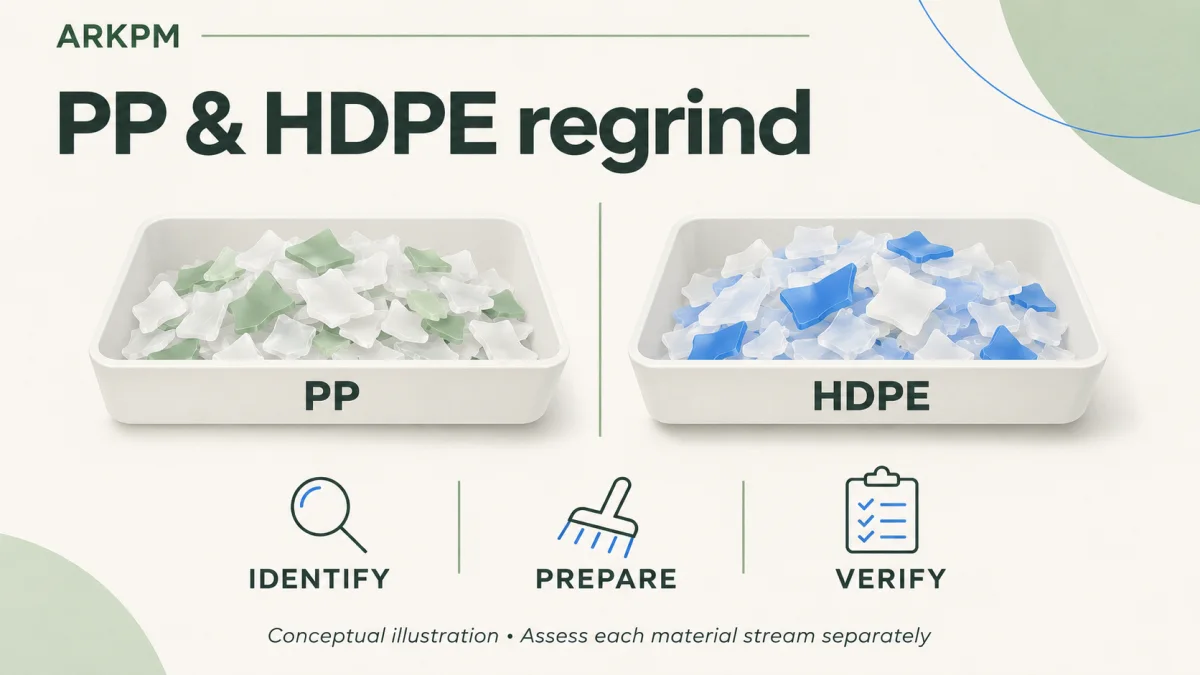
Depending on the intended application, the acceptance plan may address moisture, melt flow, contamination, colour, pellet consistency, odour or other buyer-relevant properties. Specify the sampling method, test conditions, responsible laboratory and decision rule. Do not invent a universal threshold that supposedly fits every recycled polymer or end use.
Keep first-pass accepted output separate from material that needs another processing pass. If reprocessing is required to meet the specification, its additional energy belongs somewhere in the production accounting. Do not count the same material twice in the accepted-output denominator.
A trial can temporarily label output as awaiting test results. Once testing is complete, update the accepted mass and recalculate the energy intensity. This is preferable to declaring all collected pellets accepted simply because they were bagged.
Quality and energy must be considered together. Reducing a process step may lower electricity use while changing the pellet specification. A procurement comparison should not reward a lower energy number obtained by delivering a different product.
Separate Stable Production from Whole-Run Performance
A stable production interval can help assess the machine under controlled conditions. Whole-run performance helps assess what operating that machine may cost. Buyers benefit from seeing both.
For the stable interval, define how readiness is established and record its duration, energy and corresponding accepted output. Avoid selecting only the best few minutes while excluding normal disturbances without disclosure.
For the whole run, identify whether preheating, start-up purge, waiting, screen changes, stoppages and shutdown are included. Report their energy and time separately where practical, then show the total within the agreed boundary.
Do not divide whole-shift electricity by a selected peak production rate. Numerator and denominator must cover compatible intervals. Where material takes time to travel through the line, allow for that delay or reconcile inventories at the beginning and end.
Repeat the test with representative feedstock variations rather than relying on a single attractive run. Summarize pooled energy intensity as total measured kWh divided by total accepted tonnes. A simple average of individual kWh-per-tonne values can mislead when run sizes differ.
A 2026 facility study by Bozdoğan, Tutumlu and Atmaca used twelve months of meter-based operating data to assess mechanical recycling. Its long observation period supports the practical value of looking beyond a brief demonstration; its environmental assessment is not a substitute for your tariff or an ARKPM machine trial. Read the primary research.
Compare Drying Configurations Without Moving Costs Outside the Boundary
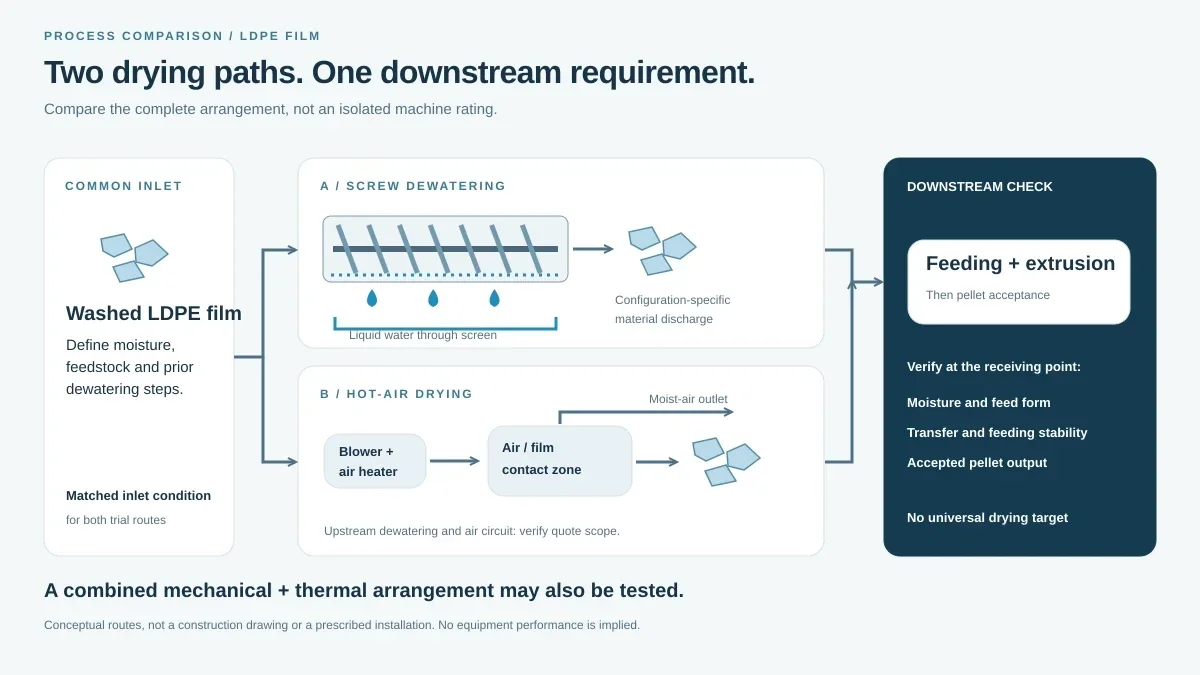
For film recycling, evaluate drying and pelletizing as connected operations. If one proposed configuration requires additional preparation before extrusion, its energy should not disappear from the comparison simply because the equipment sits outside the pelletizer frame.
Ask each supplier to identify the feed condition its extruder requires and demonstrate that condition using representative material. Record incoming moisture, discharge moisture, bulk density and accepted pellet throughput alongside electricity consumption.
Compare mechanical dewatering, any thermal drying and feed densification using matched boundaries and comparable feed lots. Do not assume that one configuration eliminates another operation without checking the downstream requirement.
Where thermal energy comes from gas, steam or another non-electric source, record it separately. A lower electricity reading does not by itself prove lower total energy cost. Compare the actual utility quantities and prices without disguising fuel as electricity.
The useful purchasing question is not simply “Which dryer uses less power?” It is “Which complete preparation and pelletizing arrangement produces the required accepted output at the lowest substantiated operating cost under our conditions?”
Convert Electricity Consumption into a Local Cost
Once the measurement boundary is settled, multiply kWh per accepted tonne by the applicable electricity energy rate. Use the currency and billing period relevant to the proposed installation.
If the site has time-of-use rates, calculate energy cost for each tariff interval and add the results. A flat rate can be useful for an early scenario, but label it as an assumption. Do not present a supplier’s local tariff as the buyer’s future electricity price.
Demand charges require separate treatment. They may depend on a monthly peak and the utility’s measurement rules, rather than simply on kWh consumed during the trial. Identify the applicable tariff and avoid attributing an entire site demand bill to one machine without a defensible method.
Keep fuel, water and wastewater costs visible in their own categories. Currency conversion, taxes and utility-contract changes can also affect the final commercial result. These belong in the local cost model, not in an unexplained machine-efficiency claim.
ARKPM’s recycling operating cost calculator can help organize an initial operating scenario. Its stated method calculates accepted output from incoming mass and accepted-output yield, and includes feed value, electricity, staffing and the allowances shown. It is an estimating tool, not a substitute for meter readings, tariff verification or an agreed acceptance test.
Compare Two Offers on the Same Accepted-Output Basis
Suppose Offer A gives an illustrative 400 kWh per input tonne at 80% accepted-output yield. Offer B gives 430 kWh per input tonne at 90% yield. Assume identical feed definitions, quality requirements and energy boundaries solely for this comparison.
Offer A works out to 500 kWh per accepted tonne. Offer B works out to approximately 477.8 kWh per accepted tonne. At USD 0.12/kWh, the electricity energy-charge component is USD 60.00 versus approximately USD 57.33 per accepted tonne.
Offer B has the higher input-based energy figure but the lower accepted-output energy cost. This does not automatically make it the better purchase. The yield assumptions still need evidence, and capital cost, maintenance, labour, uptime, feedstock value and product quality remain separate considerations.
Use sensitivity scenarios to see what could change the decision. Test a lower accepted yield, a lower sustained output rate and a higher electricity price. Change one assumption at a time before combining downside conditions. Do not present a scenario as a measured result.
Keep unknown costs marked as unknown rather than inserting zero. A quote with missing drying or utility information is incomplete, not necessarily efficient.
Build a Trial Record That Both Buyer and Supplier Can Review
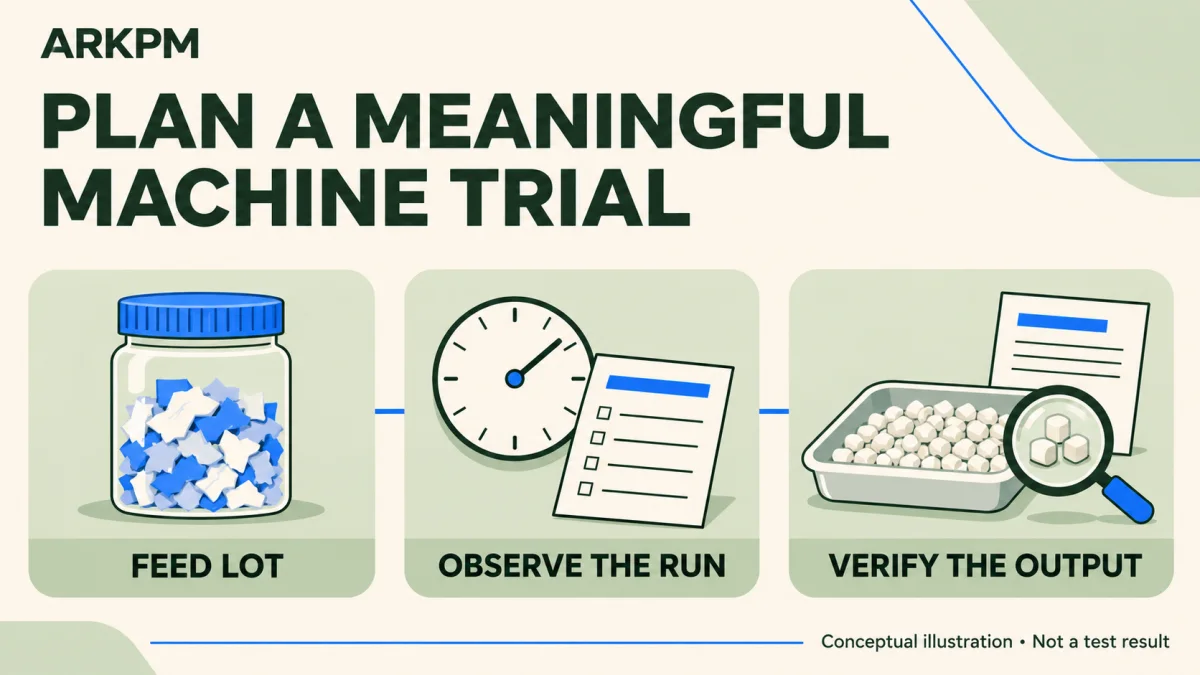
A useful record begins with the feed lot identity, polymer description, preparation state and moisture basis. Add the equipment boundary, configuration and agreed output specification before collecting energy data.
During the run, retain the opening and closing meter readings, timestamps, incoming mass, accepted mass and the separately recorded reject or residue categories. Note process interruptions and any change in configuration. Link pellet samples and laboratory results to the corresponding run rather than to a general product brochure.
The final summary should show input-based intensity, accepted-output intensity, accepted yield, tariff assumptions and exclusions. Include the raw readings and the calculation sheet so another person can reproduce the result.
Use the plastic pelletizing machine trial guide to prepare the wider supplier discussion, then add this energy-and-mass record to the agreed trial scope. Confirm the actual testing arrangements with the supplier; a guide is not evidence that a particular material has already been tested.
For purchasing, ask that the agreed report identify which values were measured, which were allocated, and which remain estimates. If performance acceptance is commercially important, define the feedstock range, output quality, measurement boundary, duration and treatment of interruptions in the written acceptance arrangement.
Make the Buying Decision on Repeatable Accepted Output
There is no single pelletizing energy-cost figure that can fairly describe every feedstock, process boundary and pellet specification. The most defensible comparison starts with matched material, transparent metering and accepted output that has actually been assessed.
Ask for both kWh per input metric tonne and kWh per accepted metric tonne. Then translate the accepted-output figure into your electricity cost while keeping non-electric utilities and other operating expenses separate.
For an ARKPM enquiry, describe the incoming material, its preparation and moisture condition, your required pellet application and the equipment boundary you want assessed. These details make it possible to discuss a relevant configuration and a meaningful trial scope rather than relying on a generic headline number.
The purchasing advantage comes from clarity: the same service, the same acceptance standard, and calculations that can be checked from the original readings.