
Mechanical Plastic Recycling: What Each Step Can and Cannot Remove
Understand the limits of sorting, washing, melt filtration and degassing, distinguish contamination from degradation, and learn how to read recycling evidence without overclaiming.

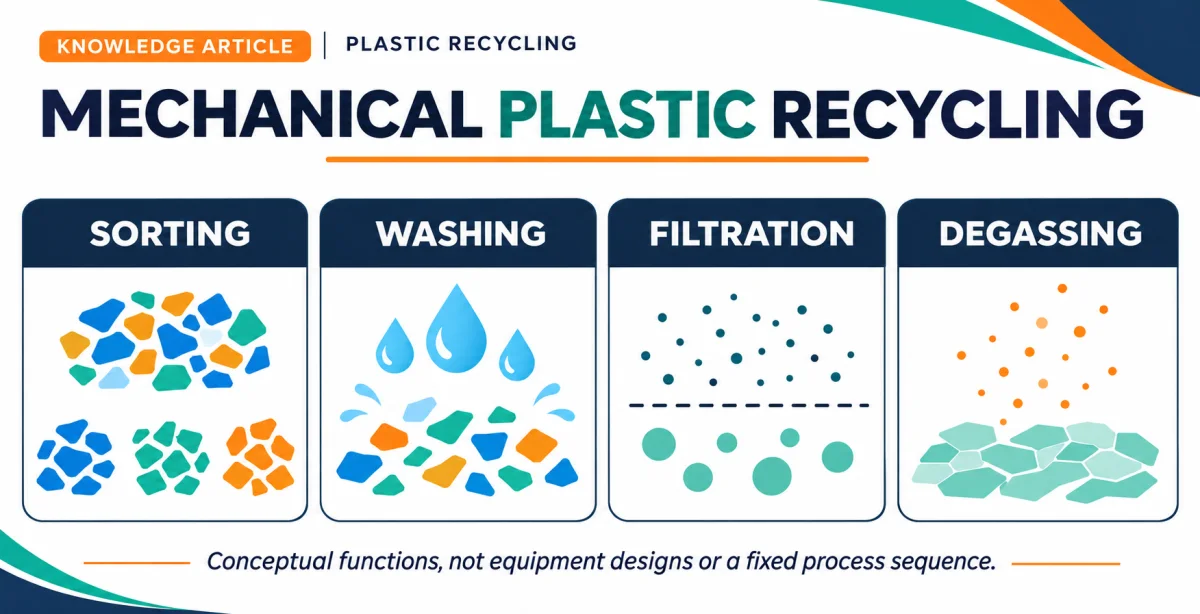
A bag of clean-looking recycled pellets does not tell you what was removed along the way. Dirt, a fragment of another polymer and a chemical absorbed into plastic are different problems. Mechanical recycling combines operations that address different parts of that problem. No single operation establishes that every contaminant has disappeared or that the material is suitable for every new use.
This guide focuses on thermoplastic packaging waste. It explains the boundaries between sorting, washing, filtration and degassing, then offers a practical framework for reading evidence about them. The framework is an editorial synthesis of the sources below, not an experimentally validated scoring system. It is designed to make claims more precise, not to recommend a universal equipment configuration.
Illustration note: The diagrams are conceptual teaching aids. Abstract symbols represent different treatment functions, not actual equipment, operator instructions or a fixed plant sequence. Real processes may combine, repeat or arrange operations differently.
What mechanical recycling changes
Mechanical recycling prepares waste polymer for another use through physical operations and reprocessing. Collection, sorting, size reduction, cleaning and reshaping may all be involved. Unlike a process intended to recover chemical building blocks, its central purpose is to retain useful polymer material. Jiang and Bateer place these methods within the broader range of recycling routes in their systematic review.
“Physical processing” does not mean the molecules remain unchanged. Heat, mechanical stresses and exposure history can affect a polymer during reprocessing. The review by Schyns and Shaver discusses contamination and degradation alongside the challenges of recovering useful packaging plastics. Removing an impurity and preserving polymer properties are therefore related but separate objectives.
A useful starting question is not “Does this line recycle plastic?” It is “What input material is being recovered, what output is needed, and which changes have been demonstrated?” That question creates a boundary around the claim. Without it, a successful result for one material can easily be mistaken for a promise about another.
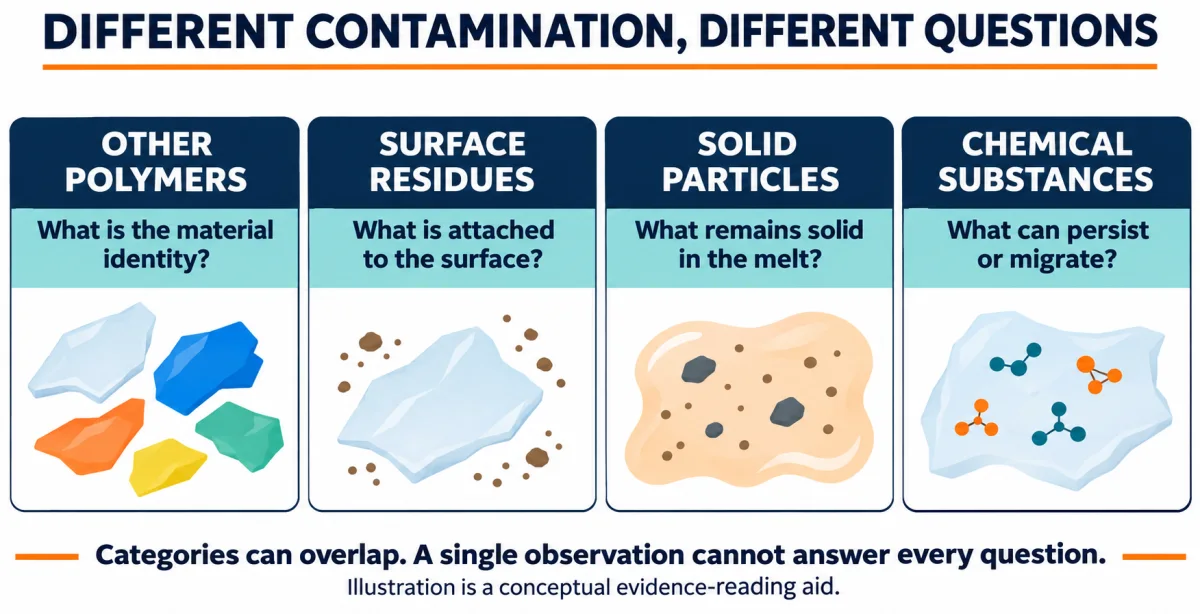
Conceptual categories for asking different contamination questions; categories can overlap and are not a complete analytical classification.
Classify the problem before selecting a treatment
Foreign objects and unwanted polymer components
Metal, paper, dirt and pieces of an unwanted polymer are not equivalent contaminants. A separation method responds to a physical or chemical difference that it can detect or exploit. Polymer identity matters because unlike polymers may not form a useful blend. NIST's plastic-sorting explanation describes how spectral measurements help identify components and why formulation complexity matters.
For a material description, distinguish an unwanted object from an unwanted component mixed into the polymer fraction. “No visible foreign objects” is narrower than “the polymer composition meets specification.” Write the narrower claim when that is all the inspection supports.
Surface residues, absorbed substances and formulation ingredients
A residue on a surface presents a different task from a substance within the polymer. A formulation ingredient may also be intentional in the original product, while being undesirable for the next application. NIST's composition-analysis research considers polymer distributions, additives, impurities and extractable or leachable compounds as distinct parts of characterization.
Do not assume that a substance is harmless because it was originally intentional, or that every original ingredient must be removed. The relevant question is whether the recovered material satisfies the requirements of its proposed use. An honest assessment identifies which substances were investigated and which remain outside its scope.
Polymer degradation is not dirt
Changes in the polymer itself cannot be described adequately as surface contamination. A cleaner sample can still have an altered molecular structure or performance history. This distinction prevents an important misunderstanding: a washing improvement does not automatically demonstrate restoration of the original resin.
The review Molecular Pathways for Polymer Degradation during Conventional Processing, Additive Manufacturing, and Mechanical Recycling distinguishes thermal, mechanical, oxidative and hydrolytic mechanisms. These mechanisms should not be collapsed into one universal explanation for every change observed in a recycled sample.
Sorting: identify the difference the separator can use
Sorting is not a single test for “good plastic.” A method may distinguish polymer type, color or density, but the result only establishes separation according to the characteristics it uses. A fraction selected by color has not thereby been demonstrated to be chemically pure.
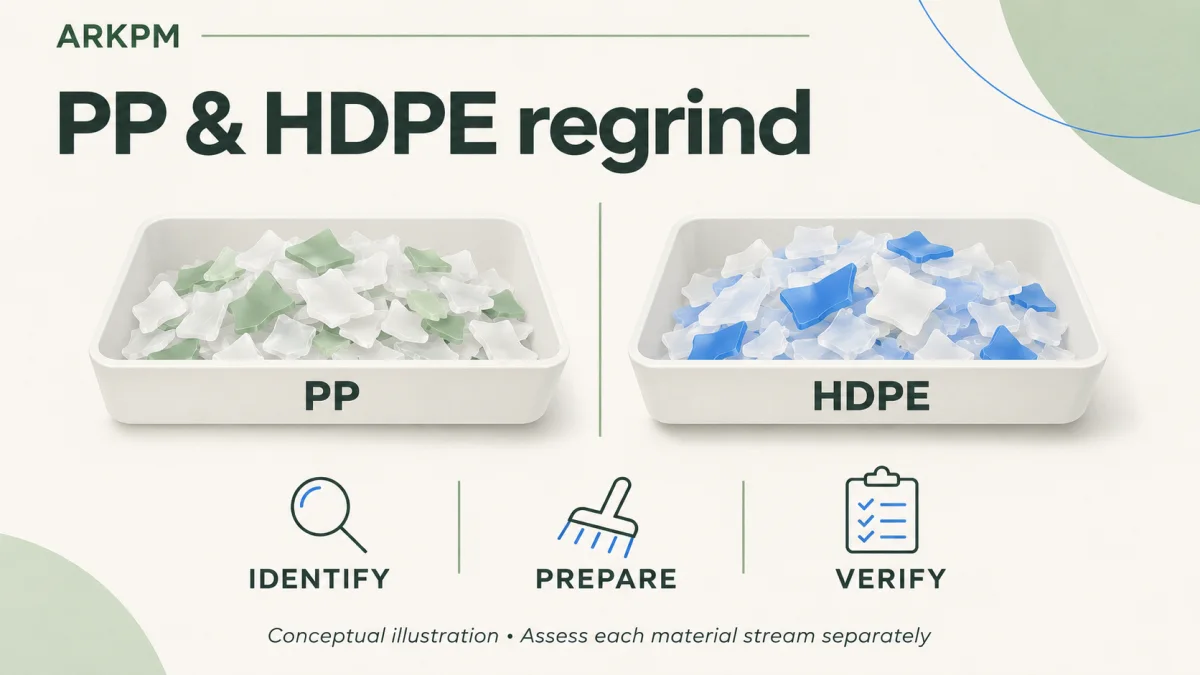
Density separation illustrates this boundary. It can help separate material groups with different densities, but overlapping densities limit what it can resolve. The review Managing Plastic Waste: Sorting, Recycling, Disposal, and Product Redesign discusses gravity-based sorting and the influence of contamination. A density-separated polyolefin fraction should not automatically be described as pure PE or pure PP.
When assessing a sorting claim, record both the target and the checked result. Was the task to remove a particular unwanted polymer, recover a target fraction, or improve color consistency? Was the result checked only by appearance, or by an appropriate analysis? These questions make the description useful without pretending that every facility must use the same technology.
Washing: specify what became cleaner
Washing can reduce surface contamination, but “washed” is a description of treatment, not a complete statement of outcome. A published study of post-consumer recycled polypropylene compared material lots with different contamination levels and washing treatments using several analytical and mechanical methods. The study's design shows why washing should be evaluated through more than visual appearance.
The result from a particular waste stream does not establish the best treatment for all streams. Before transferring a conclusion, compare the material source, contaminants, treatment conditions and property measured. A process that performs well on one problem may leave a different problem largely unexamined.
For reporting, avoid the unsupported sentence “The material is clean.” A stronger sentence names the observation: a defined residue was reduced under stated conditions, or a selected property changed in a specified test. If the study did not assess other chemical contaminants, that limitation belongs beside the result rather than being hidden in a general claim.
Melt filtration: a particle-removal task with limits
A melt filter is not a universal chemical purifier. Its role concerns particles that can be retained under the relevant processing conditions. A contaminant's state and size matter. It is therefore unsafe to assume that anything initially visible in a feedstock will remain a removable solid once the material is processed.
Langwieser and Fischer's study of single and double filtration examined separately collected Austrian post-consumer PE film on industrial-sized equipment. It compared filtration arrangements using measures including melt flow, ash, oxidation behavior and optical contamination. Its scope matters: it was not a test of every recycled polymer, input quality or end product.
The paper also raises the question of whether an additional filtration step is necessary for relatively clean input. That is a useful caution against equating more equipment with a better outcome. The decision should be tied to the contaminant problem and the required product, with evidence about both improvement and material effects.
Degassing: volatility is not the same as visibility
Degassing addresses substances that can leave the polymer under the conditions provided. It is different from retaining solid particles. A vent, vacuum connection or reduction in odor does not by itself demonstrate removal of every relevant compound.
Czaker, Mager and Fischer studied contamination across a polypropylene recycling chain using two post-consumer streams. Their findings included differences across stages and persistence of some compounds. The study also found trade-offs under particular washing conditions. These observations concern the tested PP streams, treatment sequence and analytical approach, not a universal removal rate for plastic recycling.
To interpret a degassing claim, ask which substances or analytical signals were measured, at which sampling points, and under what conditions. A result for volatile compounds does not automatically answer questions about low-volatility substances, polymer composition or remaining particles. Keep the measured outcome separate from the wider outcome a reader might mistakenly infer.
PET and polyolefins do not have identical preparation problems
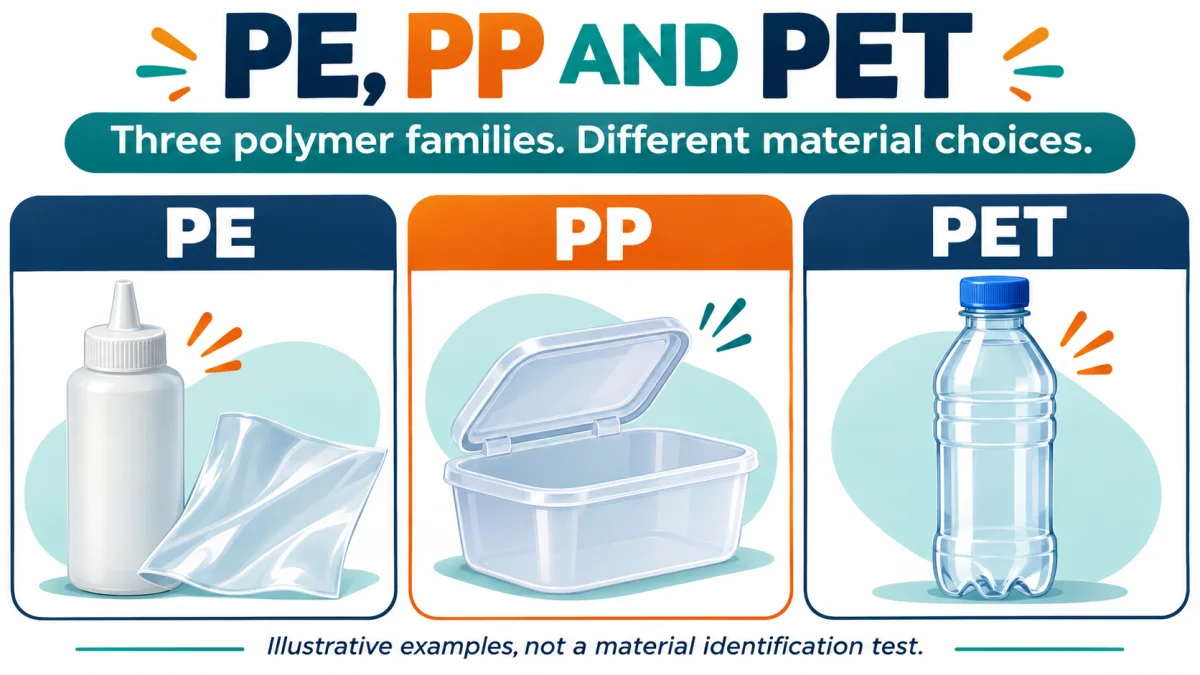
PET is a polyester; PE and PP are polyolefins. That difference matters when discussing moisture and reprocessing. For PET, residual moisture can contribute to hydrolysis during melt processing, affecting chain length and melt behavior. The review Rheology of Recycled PET discusses these interactions.
This does not supply a universal drying recipe, and it does not mean wet PE or PP feedstock can simply be ignored. It means that the reason for controlling moisture and the evidence needed should be stated for the actual material and operation.
Separate “washed,” “visibly dry” and “measured to meet the applicable moisture requirement.” They are different claims. Likewise, do not transfer a finding from a PP contamination study directly to PET merely because both are packaging plastics. Match the explanation to the polymer, the preparation history and the question being investigated.
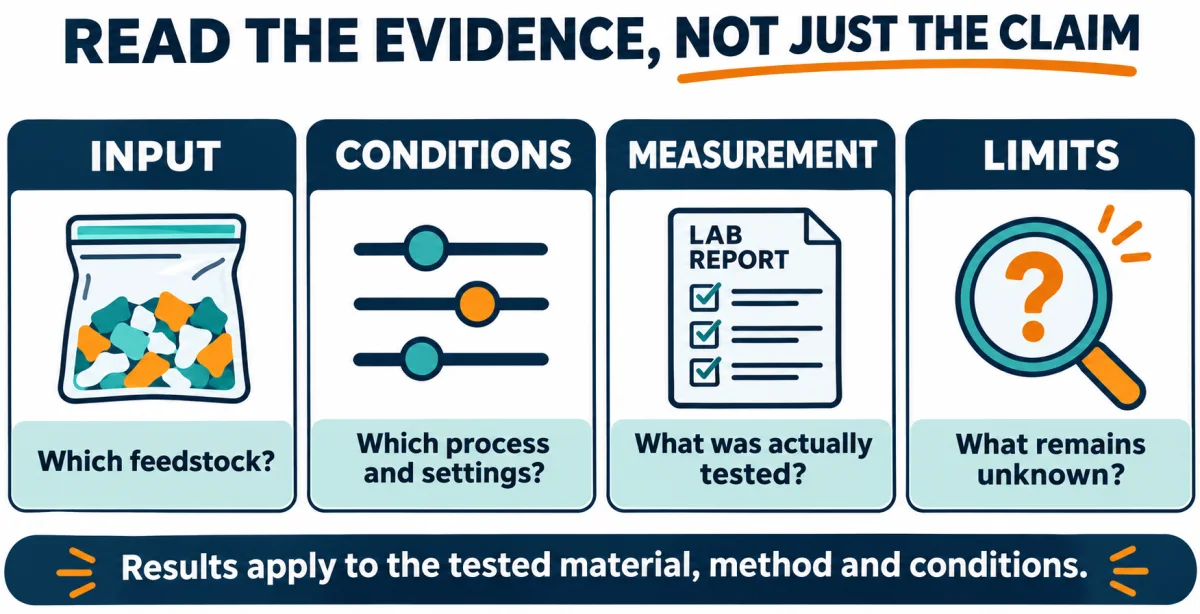
Read the input, conditions, measurement and limits together. This is an editorial reading aid, not a certification or validated assessment method.
Four checks for reading a recycling result
The following framework is our editorial reading aid. It is not a standard, certification checklist or replacement for laboratory judgment. Its purpose is to expose missing context before a result becomes a broad claim.
Check one: the material boundary
Identify exactly what entered the study. A separately collected film fraction, a mixed packaging fraction and a well-documented production scrap are not interchangeable inputs. Record the stated polymer, source, previous preparation and relevant uncertainty. If the source only describes one lot, do not quietly rewrite the result as applying to every future lot.
Then identify the output being evaluated. A pellet measurement, a laboratory test piece and a finished article are different observation points. Ask whether the conclusion actually concerns the output you need. This simple distinction often reveals why two apparently conflicting reports may be answering different questions.
Check two: the measurement boundary
Write down what the test directly measured before interpreting its meaning. Particle observations concern particles detected by that method. A thermal result concerns behavior under a temperature program. A mechanical result concerns a specimen and procedure. These may complement one another, but they are not substitutes.
NIST's description of differential scanning calorimetry illustrates the importance of a defined measurement: thermal transitions are observed through heat-flow behavior. Such a measurement can inform material characterization without establishing all aspects of purity or performance. Keep the question addressed by the measurement visible when summarizing the finding.
Check three: the comparison boundary
Ask what changed between the samples being compared. If input source, preparation and processing all differ, a reader should be careful about attributing the entire difference to one machine or treatment. Check whether the report includes an appropriate comparison and whether the stated conclusion follows the comparison actually made.
Do not create a precise percentage improvement by combining unrelated published results. Even when two papers use similar terms, their sample preparation and measurement boundaries may differ. Describe them separately unless the evidence supports a valid comparison. A clear qualitative explanation is better than a numerical claim built from incompatible measurements.
Check four: the application boundary
Finally, connect the result to a defined requirement. A change can be measurable without establishing suitability for a new application. State which requirement was checked, which evidence supports it and which questions remain open. Avoid treating a general improvement as an automatic approval.
For a practical review note, use four short fields: material examined; treatment compared; outcome measured; conclusion supported. Add an explicit limitation when the evidence leaves one. This is a way of organizing published information, not a claim that completing four fields validates a process.
A short worked reading exercise
Consider a hypothetical report that says a filtered sample contained fewer optically detected particles than its comparison sample. This is an invented teaching example, not a result from an ARKPM trial. A careful reader would first identify the two samples and the optical method. Next, they would check whether the report held other relevant conditions comparable. Only then would they summarize the observed particle result.
The reader would not extend that statement to dissolved chemicals, polymer purity, food-contact suitability or long-term durability without additional evidence. Those are different questions. If the report also contained a mechanical test, that result would be described separately, with its own specimen and conditions. The exercise illustrates a discipline of interpretation: preserve the narrow meaning of each observation before deciding how the observations fit together.
Food-contact suitability is a separate determination
Clean appearance, lower odor and successful pellet formation do not establish food-contact suitability. The FDA's recycled-plastics overview identifies concerns involving contamination, material source and additives, and considers the proposed use. Its Chemistry Considerations guidance (July 2021 revision) discusses physical reprocessing, exposure to chemical contaminants and surrogate contaminant testing. The guidance contains nonbinding recommendations, not a blanket approval.
Do not turn that into “FDA-approved recycled plastic” simply because the polymer family is commonly used in packaging. Nor should a research paper be described as granting a regulatory clearance. Requirements and conclusions must be checked for the relevant process, material, use and market.
This guide explains why those questions are separate. It does not provide a food-safety finding, legal opinion or approval for any ARKPM machine or recycled resin.
What a careful conclusion sounds like
A defensible conclusion usually becomes more specific, not more dramatic. Instead of saying a process “removes contamination,” identify the contamination examined and the evidence for its reduction. Instead of saying the material “is suitable,” identify the application and the requirements assessed. Instead of saying a research result “proves the technology,” explain the conditions under which the finding was obtained.
Unknowns are not necessarily failures. They are boundaries on what can presently be claimed. Keeping those boundaries visible helps readers distinguish a useful study from a universal promise, and a process improvement from a complete material qualification.
The central lesson is simple: different steps solve different problems, and the strength of a recycling claim depends on how clearly its evidence is connected to the material and intended use. Read the material description, treatment description and measurement description together. If one is missing, retain that uncertainty rather than filling the gap with an assumption.
Sources and where they apply
Jiang and Bateer, A systematic review of plastic recycling: technology, environmental impact and economic evaluation (2025), DOI. Original-source locator: “Mechanical recycling” subsection within the review of recycling technologies.
Schyns and Shaver, Mechanical Recycling of Packaging Plastics: A Review (2021), DOI. Original-source locators: Sections 2.1 “Melt Blending” and 2.2 “Waste Sorting for Recycling.”
Prior, Oliveira and Zhiltsova, Assessment of the Impact of Superficial Contamination and Thermo-Oxidative Degradation on the Properties of Post-Consumer Recycled Polypropylene (2023), DOI. Original-source locators: Abstract and “Materials and Methods,” describing the material lots, washing and characterization.
Langwieser and Fischer, Investigation of the Impact of Single and Double Filtration Systems on Post-Consumer PE Film Waste (2024), DOI. Original-source locators: Abstract and “Materials and Methods,” describing the PE film input, pretreatment and filtration comparison.
Czaker, Mager and Fischer, Contamination levels in polypropylene waste streams throughout a mechanical recycling process (2026), DOI. Original-source locators: “Materials and methods”; “Results and discussion,” especially “VOC evolution throughout the recycling process” and “Washing experiments.” Findings are stream-specific.
U.S. Food and Drug Administration, Use of Recycled Plastics in Food Packaging (Chemistry Considerations): Guidance for Industry, July 2021 revision of guidance originally issued in August 2006. Original guidance PDF. Original-source locators: Section III.B “Physical Reprocessing: Secondary Recycling” (p. 5); Section IV “Exposure to Chemical Contaminants” (p. 7); Section V “Surrogate Contaminant Testing” (p. 9). These are nonbinding recommendations.
Additional university, government and research sources are linked beside the relevant explanations. The evidence-reading framework is an editorial synthesis, not a method attributed to any one paper.
Prepared by ARKPM Editorial, part of a plastic machinery business. This educational synthesis does not report original experiments or independent expert review.