
PE vs PP vs PET: A Practical Guide to Plastic Materials and Recycling
Compare PE, PP and PET through their structures, everyday properties, identification and recycling limits. Learn why resin family, product design and grade-specific evidence all matter.

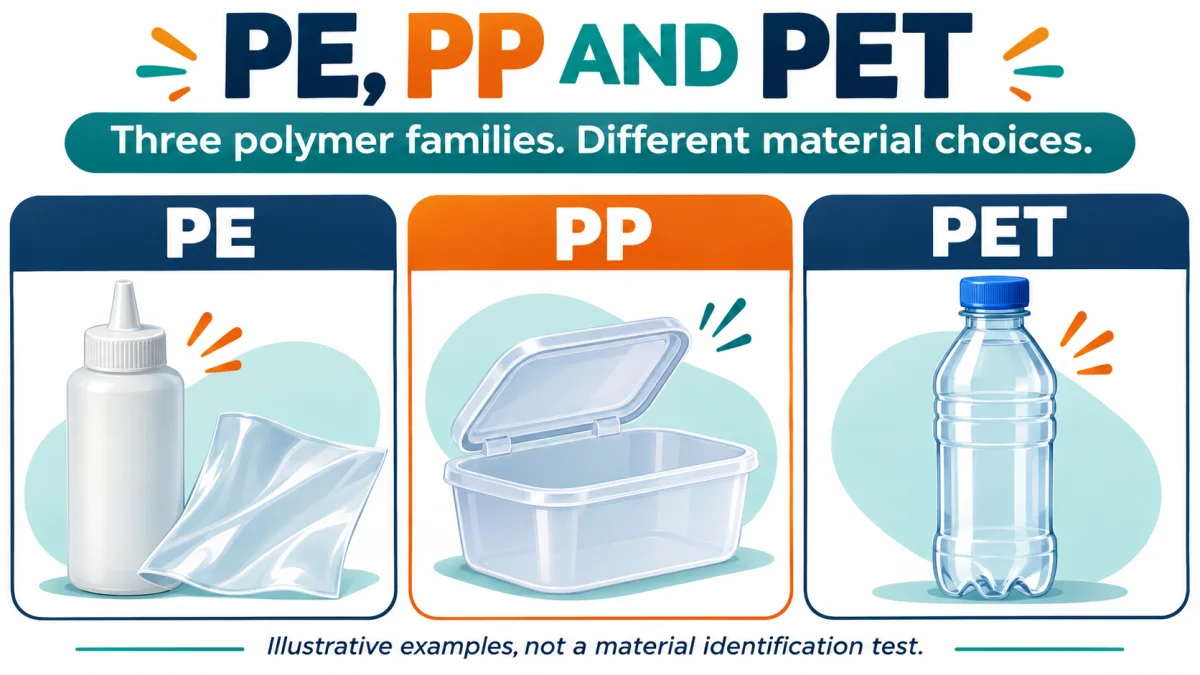
A flexible bag, a detergent bottle, a food tub and a clear drink bottle may all be called plastic, yet they do not behave like the same material. The difference begins with their polymer molecules, but it does not end there. Chain structure, processing history, additives and the design of the finished item all matter.
This guide compares polyethylene (PE), polypropylene (PP) and poly(ethylene terephthalate) (PET). It explains the chemistry without turning a material name into a performance guarantee. The purpose is to help readers ask better questions about a product, a resin specification or a recyclable material stream, rather than choose a processing recipe from a general comparison.
Start with three different questions
When someone asks, “What plastic is this?”, they may be asking about chemical identity, the material grade, or the complete product. These are related questions, not interchangeable ones. PE is a polymer family. A particular PE grade is more specific. A finished bottle also has a shape, wall thickness, color and manufacturing history. The answer needed for sorting may not be enough for designing a replacement part.
Keep those levels separate as you read a specification. “Made from PP” tells you less than “made from this identified PP grade, tested under these conditions.” Likewise, “recycled PET” describes a material and its history, but it does not by itself describe its suitability for a particular end use. A useful comparison starts by stating what is being compared and what decision the comparison is meant to support.
PE: the same basic chemistry can produce very different materials
Polyethylene is built from repeating ethylene units. Its main chain consists of carbon atoms, with hydrogen atoms attached. Chains can differ in length and branching. These differences help explain why the PE family includes both flexible films and comparatively rigid containers. The labels HDPE and LDPE stand for high-density and low-density polyethylene; they do not mean that one is simply a thicker version of the other.
Carnegie Mellon University's introduction to polymer architecture uses HDPE and LDPE to explain the distinction. Less-branched chains can pack more closely, while substantial branching disrupts that packing. This is a useful starting point for understanding differences in density and flexibility. It is not a complete description of every commercial grade, and it should not be read as saying that all HDPE chains are perfectly branch-free.
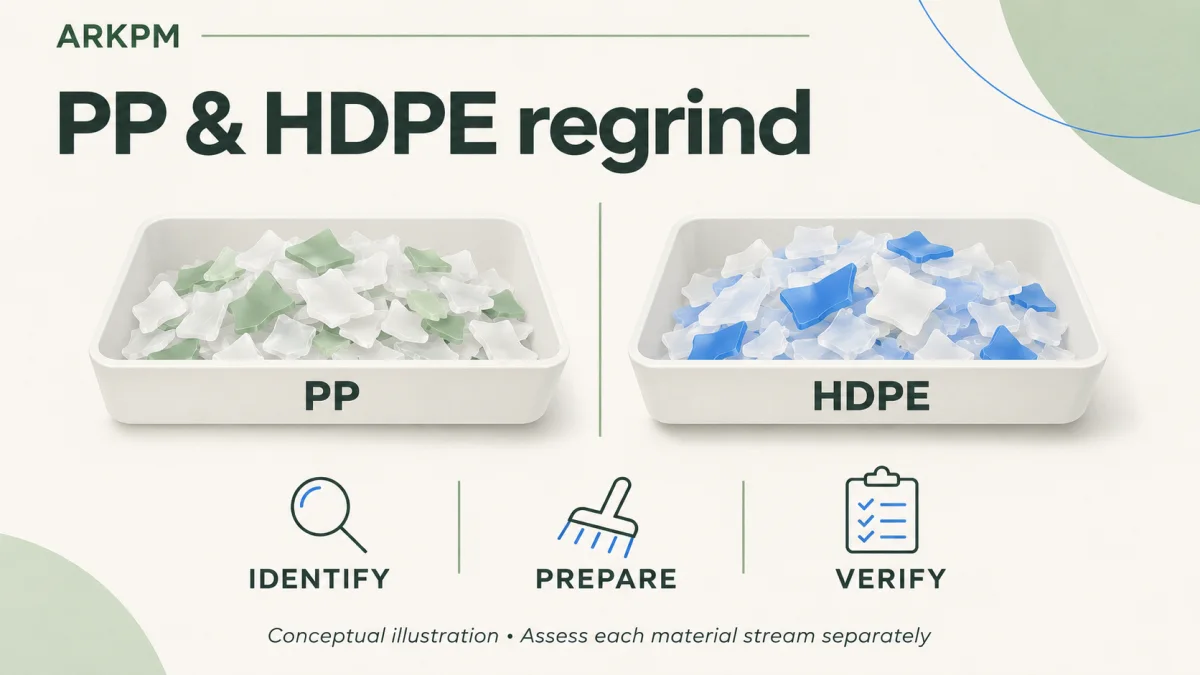
For practical discussion, describe a PE material using more than its abbreviation. Ask whether the identification refers to a film, a molded article, a supplier grade or an unknown mixture. That keeps a familiar family name from hiding the very differences the comparison needs to explain.
PP: a small chemical change with important consequences
Polypropylene is related to PE, but its repeating units include a methyl side group. The arrangement of those groups along the chain is called tacticity. Their arrangement affects how regularly chains can organize. PP is therefore not just PE with a different trade name, and its behavior cannot be inferred by changing the letters on a PE specification.
Another distinction is between a homopolymer and a copolymer. A homopolymer uses one kind of monomer; a copolymer incorporates more than one. Purdue University's polymer terminology guide explains both copolymer arrangements and tacticity. These terms describe molecular structure, not a ranking from poor to good material. A formulation is selected for a combination of requirements, rather than because one label is universally superior.
If a report compares “PP” with another plastic but does not identify which PP material was tested, treat its conclusion as a starting point. Ask for the grade and test conditions before extending it to a different product. A carefully qualified comparison is more useful than an impressive-sounding claim that leaves the actual material unspecified.
PET is a polyester, not another form of PE
The name polyethylene terephthalate can be misleading if it is shortened mentally to polyethylene. PET belongs to the polyester family. Its chain contains ester linkages and aromatic rings, unlike the hydrocarbon backbone of PE. The American Chemical Society's PET profile describes its formation from ethylene glycol and terephthalic acid, or a related commercial starting material.
PET appears in bottles, films and fibers. In textiles, it is commonly called polyester. A drink bottle and a polyester garment can therefore share a broad polymer identity while being very different products. That shared name does not mean they have the same additives, construction, specifications or collection route.
This is a useful example of why vocabulary matters. PE, PP and PET are not three interchangeable names for a single substance. Equally, identifying PET does not reveal everything about the article in front of you. Keep the chemical family, the particular material and the finished product in view together.
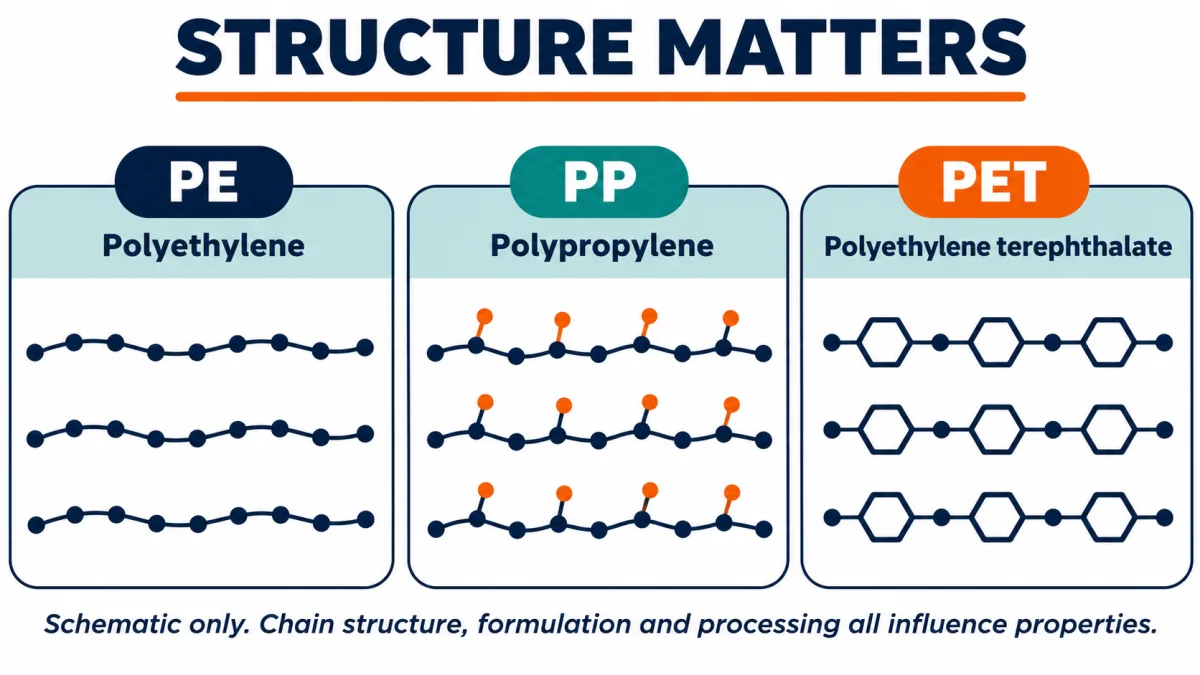
Conceptual comparison of polymer chain features. Not a chemical structural formula or a scale drawing. PE branching and atomic detail are intentionally omitted.
Crystallinity explains part of the difference, not all of it
In a polymer, crystallinity refers to regions where chain segments adopt an ordered arrangement. Other regions are less ordered. The word does not imply that a plastic object is one large crystal. A material's crystalline structure can depend on the polymer itself and on how it was cooled, stretched or otherwise processed.
PET provides a particularly helpful illustration. The review Crystallization of Poly(ethylene terephthalate) describes how cooling and subsequent thermal treatment can produce different structural states. The same broad polymer identity can therefore lead to different material behavior. It is too simple to assume that a clear object has one universal structure or that every PET product responds to heat in the same way.
For a reader comparing materials, the key lesson is to avoid treating chemical identity as the entire explanation. A statement about “PET properties” should say whether it describes a particular specimen, a grade, or a broad tendency. These distinctions become especially important when comparing published test results with an actual manufactured part.
Why a melting temperature is not a safe-use temperature
Melting, glass transition and performance under load answer different questions. Melting concerns the loss of crystalline order. A glass transition concerns changes in molecular mobility in the amorphous portion. Neither observation alone establishes how a finished product will perform in its intended use.
The ISO 11357 series overview treats glass transition, melting and crystallization as distinct thermal phenomena. That is why a single temperature copied from a general material table is not a complete design specification. The test method, sample condition and property being measured need to accompany the number.
Before calling one material “more heat resistant,” define the requirement. Does the part need to retain its shape, carry a load, preserve appearance or remain suitable for a particular contact application? A useful comparison is written around that requirement. This article deliberately does not provide universal operating temperatures: such values would invite readers to apply a general family description to an unverified grade or finished article.
Additives and grade differences remain important
Plastic products contain more than polymer chains. Pigments, fillers and other additives can be used to adjust appearance or performance. NIST's explanation of plastic identification describes why determining the main polymer is only one part of understanding the material. It also explains how spectroscopy uses characteristic interactions with light to help identify a sample's components.
For the reader, this means that two objects bearing the same resin code should not automatically be treated as equivalent. The code is not a complete formulation. Nor can color, transparency or the feel of a surface reliably supply all the missing information.
A good material description records what is known and leaves uncertainty visible. “Supplier-identified HDPE, grade documented” and “mixed rigid items believed to be PE” are very different statements. The second is not useless, but it should not be presented with the confidence of the first.
Resin identification codes are not recycling instructions
The common code system associates PET with 1, HDPE with 2, LDPE with 4 and PP with 5. These identifiers help describe resin types. They do not certify that a product will be accepted by a collection service, successfully sorted or recycled into a specific new product.
The US Environmental Protection Agency explicitly warns that a resin code does not guarantee local recyclability. Collection rules differ, and a local program may accept some plastic products but not others. Check the current instructions for the actual item rather than relying only on the number molded into it.
For businesses, the equivalent question is not merely “Can this polymer be recycled?” It is “Who accepts this particular material stream, in what condition, and for what recovery route?” For households, follow the local program's instructions. In either case, a technically meaningful polymer identification and an available recycling service are separate pieces of information.
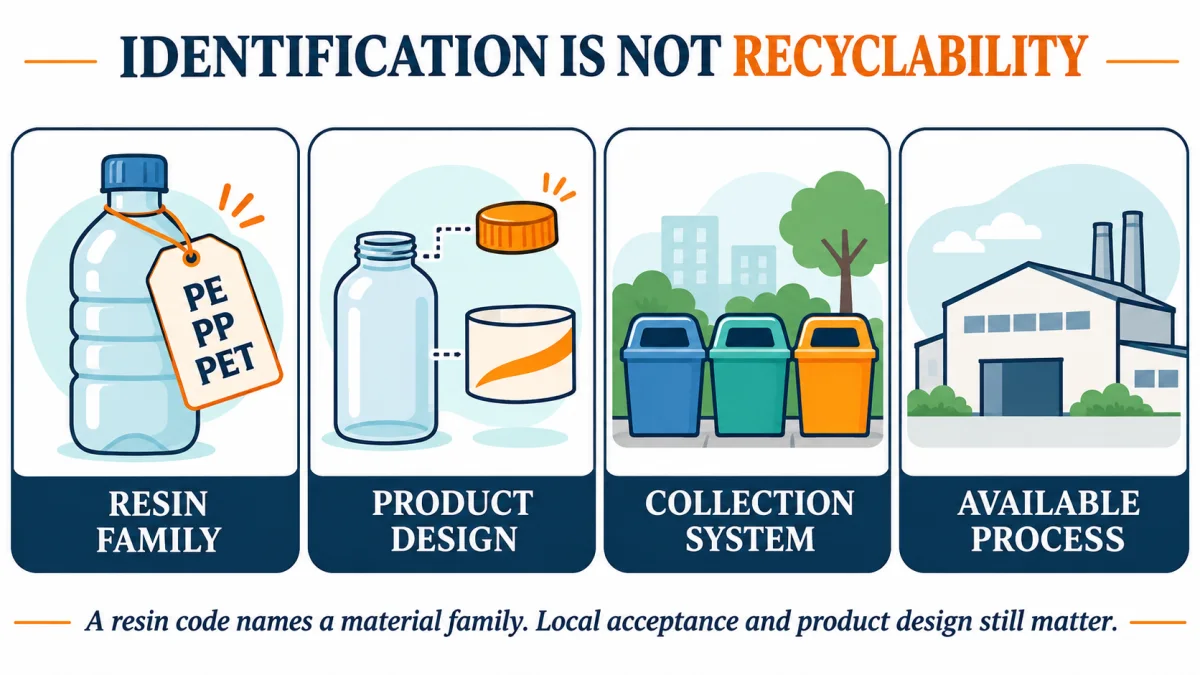
Polymer identification is one part of a recycling decision; local acceptance and the complete product also matter.
Why PE and PP should not be assumed to mix successfully
Because PE and PP are related polymers, it can seem reasonable to combine them. Related chemistry does not automatically produce a well-performing blend. NIST's microscopy explanation of recycled polymer behavior shows why adhesion and crystallization matter when different plastics are combined. Poorly joined regions can contribute to weak or brittle behavior.
That does not mean useful polymer blends are impossible. It means their performance needs to be demonstrated rather than assumed. A deliberately designed blend is not the same as an uncontrolled mixture of unidentified waste.
NIST's composition and sorting research also highlights variation within polyolefin classes, including molecular mass, comonomer distributions and additives. Its research on compatibilizers examines connections between interfaces and bulk properties. This is a more realistic picture than the idea that one additive, or one percentage of mixed material, will solve every compatibility problem.
PET moisture control is about chemistry, not just surface dryness
Moisture is especially important when PET is heated for melt processing. Water can participate in hydrolysis, shortening polymer chains and changing the material. A flake or pellet that looks dry is not necessarily adequately prepared for the intended operation.
The review Rheology of Recycled PET discusses residual moisture, degradation and changes in melt behavior. The practical lesson is to verify preparation against the actual material and process requirements. It is not to copy a drying time or temperature from an unrelated example.
Distinguish three claims: the material has been washed, its visible surface is dry, and its moisture condition has been measured and found suitable. Only the last directly addresses a specified moisture requirement. A clear report says which claim is supported. It also avoids applying PET's particular chemistry as an identical explanation for every other plastic family.
Different tests answer different material questions
Thermal analysis
Differential scanning calorimetry, or DSC, measures thermal behavior by comparing a sample with a reference during a controlled temperature program. NIST's DSC instrument description explains how transitions such as crystallization and melting appear in the measurement. Such information helps characterize a material; it is not a universal pass-or-fail verdict for every use.
When reading a thermal report, ask what sample was tested and what the analyst concluded. A graph without the sample identity, procedure and interpretation is easy to overread. Treat the laboratory result as evidence for a defined question, not as a substitute for all other material testing.
Melt flow and mechanical behavior
A melt-flow value describes flow under specified test conditions. It should not be compared casually with another value obtained at a different temperature or load. The published scope of ASTM D1238 illustrates that the result belongs to a defined extrusion-plastometer method. A reported number is not a standalone description of strength, toughness or product durability.
For a replacement-material decision, request evidence tied to the intended product. Matching one flow value does not answer every mechanical question. Conversely, a difference in one measured property does not by itself establish that the material is unsuitable. The requirement and the evidence must be considered together.
Recycled content is a history, not a complete specification
A recycled material may contain useful polymer whose identity is well established, but its composition and previous exposure still matter. A study of commercial post-consumer PE and PP recyclates used several complementary characterization methods, including thermal analysis, infrared spectroscopy and imaging. This illustrates why one visual observation is not a substitute for a material assessment.
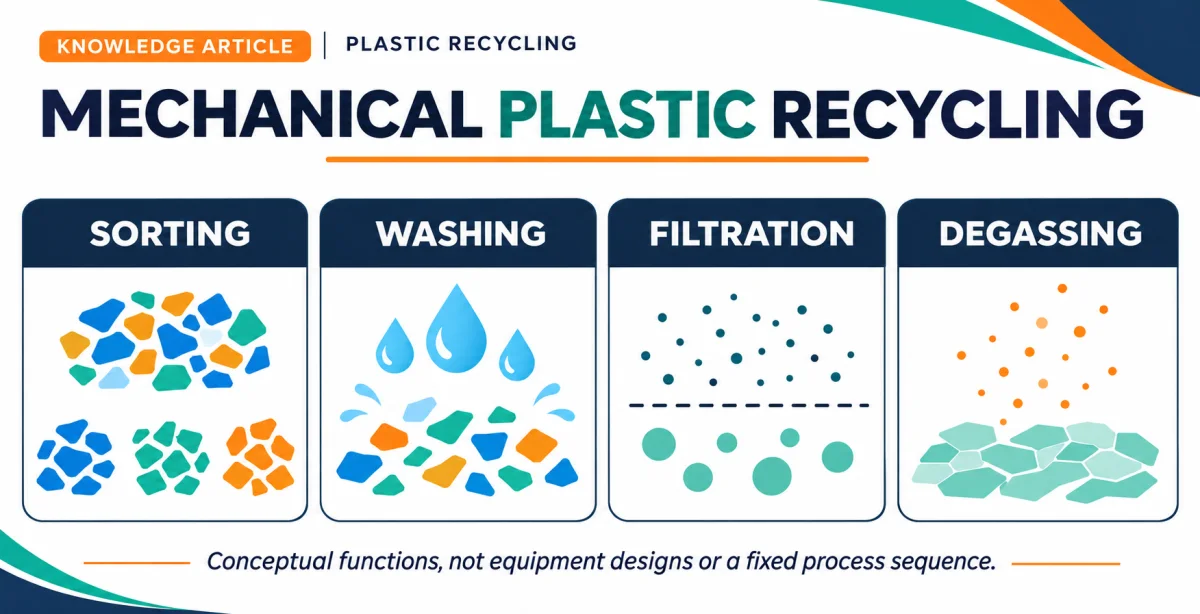
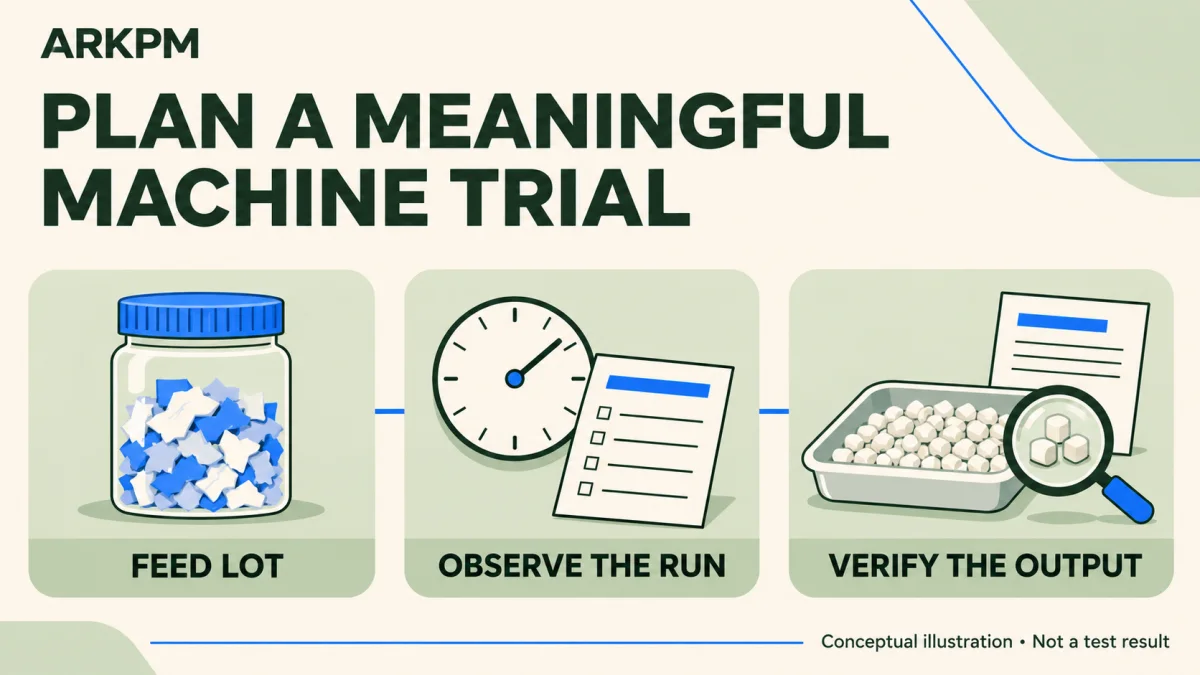
For an unfamiliar batch, begin with documentation: source, polymer identification, preparation history and relevant test reports. Separate confirmed information from a supplier's broad description. If a decision depends on a property that has not been measured, say so rather than borrowing a value from a generic PE, PP or PET table.
This approach does not assume recycled material is always inferior or automatically equivalent. It asks the more useful question: is this identified material suitable for this specified application, with evidence that covers the decision?
Food-contact suitability needs its own assessment
Neither the letters PET or PP nor a recycled-content claim establishes food-contact suitability. The FDA's recycled-plastics guidance overview considers material source, possible contamination, the recycling process and proposed conditions of use. These are specific questions, not a blanket endorsement of an entire polymer family.
Do not infer that an unknown resin is suitable because a different product made from the same family once held food. Obtain the documentation required for the intended application and market. This guide explains material distinctions; it is not a regulatory clearance or a substitute for a qualified assessment.
The useful comparison is always specific
PE, PP and PET are valuable starting points for understanding plastics. PE demonstrates the importance of branching; PP shows why repeat-unit structure and arrangement matter; PET shows why a polyester cannot be treated as another polyolefin. None of those family names tells the whole story.
When comparing two materials, identify the grade or batch, define the application, check the relevant evidence and keep collection instructions separate from chemistry. That method is more dependable than asking which plastic is universally best. It also makes disagreements easier to resolve: instead of debating labels, you can identify the missing fact or test that would actually change the decision.
Editorial note: ARKPM Editorial is part of a plastic machinery business. This educational article synthesizes the linked public guidance, university resources and research. It does not report original experiments, certify a material, or provide a universal processing recipe. Illustrations are conceptual aids, not molecular-scale photographs or measured test results.